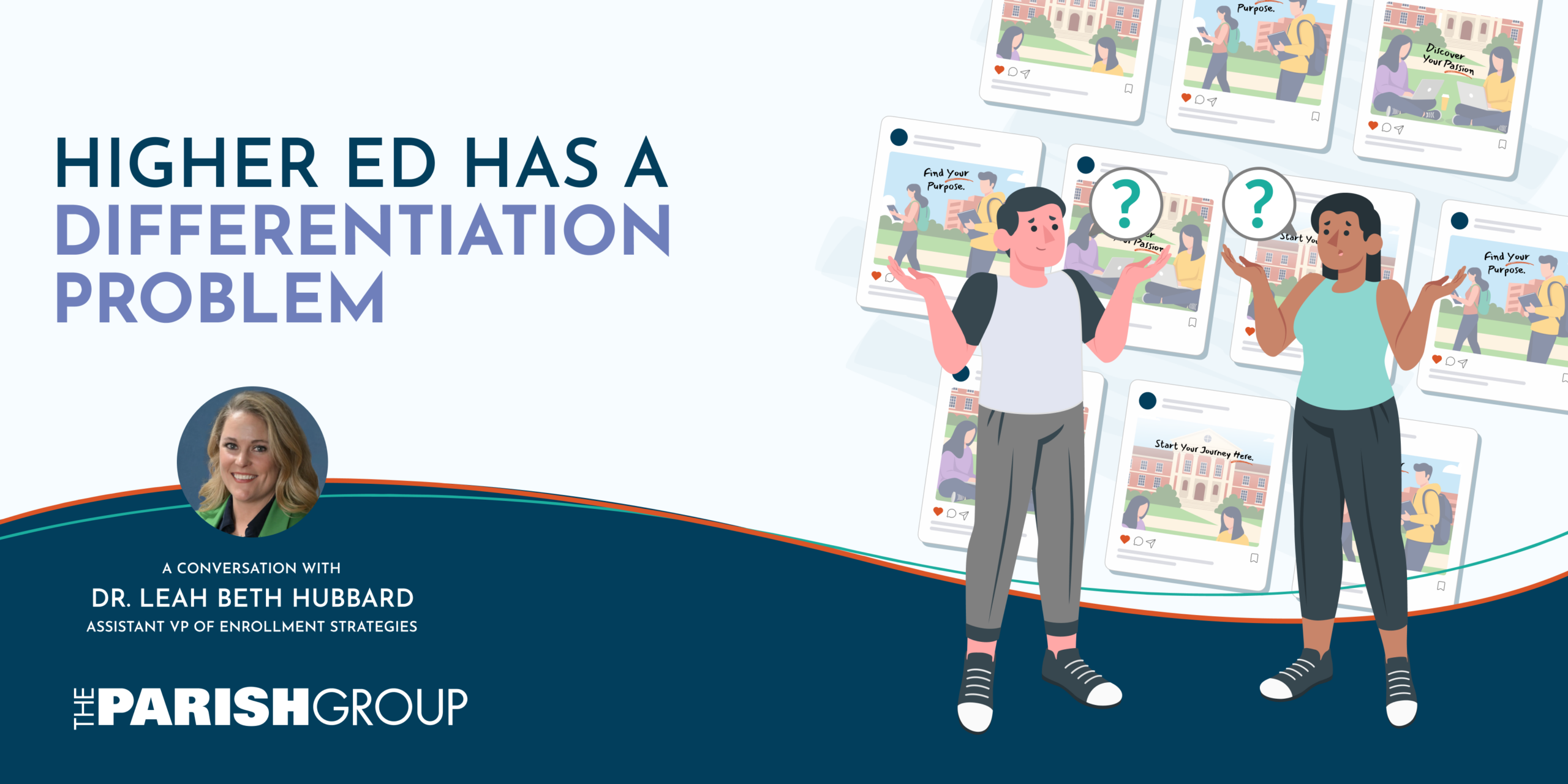

Young adults are entering higher education at a moment when questions of stability, purpose, and future direction feel increasingly uncertain. That reality is shaping not only how students think about careers and outcomes, but also how they evaluate the institutions themselves.
Research from the Harvard Graduate School of Education found that many young adults report struggling with meaning, uncertainty, and loneliness—signs of a generation seeking belonging and direction alongside long-term opportunity.
Rather than framing this as a generational critique, it’s more useful to view it as context for how expectations are shifting. Gen Z and Gen A increasingly evaluate decisions through a value-based lens rooted in trust, community, authenticity, and institutional credibility.
While we’re not going to pretend that trends, features, and legacy branding no longer matter, in an increasingly competitive higher-education landscape, well-defined, specific, recognizable values can become a major competitive advantage for institutions looking to stand out.
Values Are a Baseline Expectation for Gen Z Consumers
Being digital natives and growing up in a world of unprecedented transparency (and the ability to find information), Gen Z is perhaps the savviest generation when it comes to being consumers. This allows them to be discerning shoppers, and thus far, they’ve used that discernment to support and advocate for brands that don’t just fill a need or “provide value” but also align with their values.
Data from YouGov shows that Gen Z consumers are more sensitive to ethical and value-based brand messaging than older generations.
- Gen Z is more likely than older generations to support brands with a moral message or clear social stance.
- 65% of Gen Z say they actively like it when companies have a value-based message.
- While “wit” and “playfulness” ranked high on what Millennials looked for as consumers, Gen Z seeks “trustworthiness,” “honesty,” and “consistency”—49% prioritize showing authenticity, 53% prioritize acting genuinely, and 53% expect organizations to understand everyday challenges.
What this shows isn’t a generation demanding performative messaging, but one expecting alignment between what organizations say and do.
Why Values and Outcomes Have Become Interdependent
The most effective higher education brands aren’t choosing between purpose and practicality, but intermingling the two.
For today’s students, values are no longer a layer on top of the academic experience. They shape how that experience is interpreted in the first place: what kind of leadership an institution develops, what paths feel accessible after graduation, and whether an education translates into meaningful, real-world impact. Outcomes aren’t evaluated independently from values—they’re understood through them.
That’s where many institutions fall short. Not because they lack mission or purpose, but because they still treat those ideas as narrative rather than organizational.
In an Inside Higher Ed piece about becoming a mission-driven university, University of Texas at Austin professor Steven Minz argues that the issue isn’t the absence of purpose, but the failure to operationalize it. Mission shows up in messaging, but not always in the way programs are structured, experiences are designed, or outcomes are defined and communicated.
That disconnect can create a credibility gap that marketing alone can’t solve.
Higher education now operates in an increasingly competitive, enrollment-driven environment, where institutions must balance mission with financial sustainability and market demand. And many have failed at this. In his book, Capitalizing on College: How Higher Education Went from Mission Driven to Margin Obsessed, researcher and educator Joshua Travis Brown argues that this competitive landscape means institutions have begun to run—and thus market themselves—as businesses, treating students as consumers, and moving away from mission and values to features and new releases.
Values as a True Competitive Edge
Now, higher education operates in an increasingly business-minded environment, and prospective students evaluate institutions more like consumers. On a high level, there’s nothing wrong with admitting that. But this shift has contributed to a convergence in messaging and strategy across institutions that once differentiated themselves more clearly.
That, combined with today’s students’ heightened awareness of marketing machinations, means that increasingly, values are a way institutions can stand out, but only when they are visible, consistent, and credible across the full enrollment marketing cycle and full student experience.
If Gen Z stays consistent, and Gen A follows suit, the institutions that will achieve brand recognition in the current and next era of higher education aren’t necessarily those with the largest marketing budgets or most polished legacy, but those able to clearly define, represent, and communicate their values to the audiences who share them.
How Can Higher Education Institutions Market Their Missions and Values?
This all raises a more practical question: if values and outcomes—mission, in enrollment marketing speak—are increasingly intertwined in how students evaluate institutions, how should colleges and universities communicate that reality in a way that holds up throughout the enrollment journey?
In our piece, Rethinking How Mission-Driven Colleges Market Themselves, we look at how mission-driven institutions can translate values into marketing, storytelling, and student experience in a way that engages today’s (and tomorrow’s) prospective students.