Gen Alpha Is Closer to College Than You Think
Many folks in higher ed are still trying to understand Gen Z.
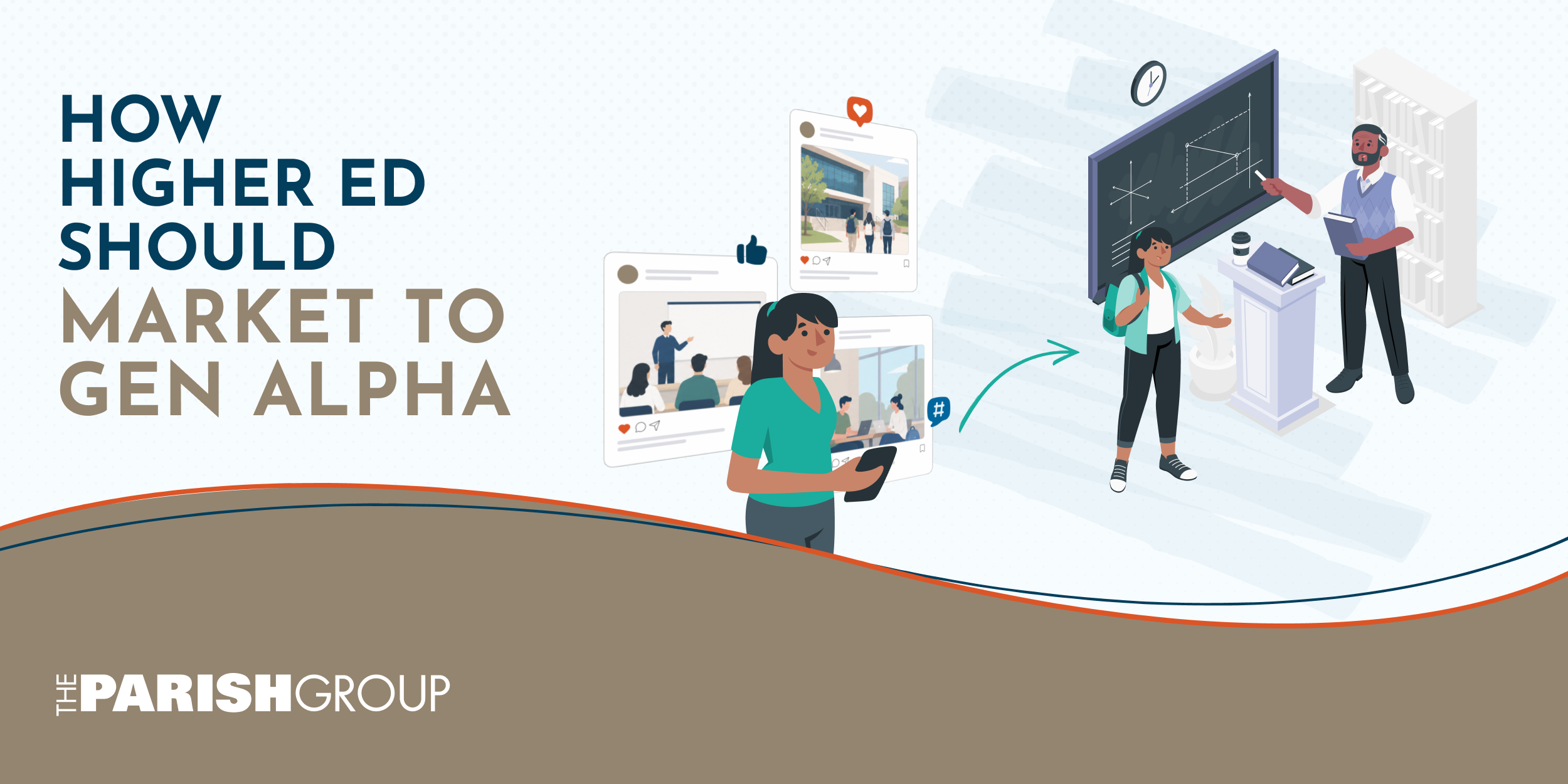
But the next generation of students is already approaching the enrollment pipeline. The first wave of Generation Alpha (Gen A) will begin entering the traditional college journey in 2028. Broadly defined as those born between 2010 and 2024, Gen Alpha will shape higher education enrollment from 2028 through the early 2040s.
And while many of today’s Gen Alpha students are still in middle school, the behaviors shaping their expectations are already influencing digital communication, technology adoption, and how younger audiences engage with institutions online.
For higher education marketers and enrollment teams, understanding this generation can help boost enrollment and retention if approached thoughtfully.
Who Is Generation Alpha?
Generation Alpha is often described as the first true AI-native and algorithm-native generation.
They were born into a world of smartphones, streaming platforms, personalized feeds, voice assistants, and on-demand content. Many have been navigating YouTube, TikTok, or streaming apps since they were toddlers. “New” technology isn’t something they adopted, but something they’ve always had.
They also experienced major educational disruption early in life. Remote learning, hybrid classrooms, and digital collaboration tools became normalized during formative years, fundamentally shaping how they think about communication and learning environments.
As a result, they’re one of the most digitally fluent—and digitally demanding (and it could be argued, digitally insular)—generations higher education has ever marketed to.
Why Higher Ed Should Pay Attention Now
It may feel early to discuss marketing to Gen Alpha, but shifts in enrollment strategy rarely happen overnight.
Website redesigns, CRM personalization strategies, content ecosystems, social media approaches, and institutional brand positioning can take years to evolve. By the time Gen Alpha students begin actively researching colleges, the institutions that experimented early may already have a significant advantage.
More importantly, many of the behaviors associated with Gen Alpha are already reshaping how younger audiences consume information today, including:
- Short-form video as a primary communication format.
- Robust answers delivered to online queries (aka, AI overviews).
- Personalized digital experiences.
- Trusting creators over brands (and sometimes…experts).
- Conversational online engagement.
These aren’t future trends. They’re tactics we’re already seeing marketers and consumers engage with.
Strategies for Marketing Higher Education to Gen Alpha
Personalize the Digital Experience
Gen Alpha is growing up in a world where personalization is the default.
Their digital experiences are shaped by recommendation algorithms, curated feeds, adaptive platforms, and AI-powered tools that respond instantly to behavior and preference. That expectation will likely carry into higher education.
Early signals suggest they may have far less patience for static websites, confusing navigation, slow communication workflows, or generic messaging.
Instead, they’ll likely expect:
- Tailored communication: messages that reflect where they are in the journey (example: a prospective student interested in nursing receives program-specific deadlines, clinical placement highlights, and outcomes—not a general admissions email).
- Intuitive digital experiences: websites that adjust based on behavior (if a student repeatedly views engineering pages, the homepage surfaces engineering faculty stories, labs, and career outcomes first).
- Mobile-first engagement: every key action is fully usable on a phone (completing an application step, scheduling a visit, or chatting with admissions without switching to a desktop).
- Immediate access to information: answers without friction (tuition, requirements, and deadlines available instantly via search, chatbot, or one-click FAQ layers instead of buried PDFs).
AI Is Reinforcing Expectations for Personalization
Gen A’s relationship with AI is especially important for higher education leaders to understand.
In a recent study, 73% of Gen Alpha respondents say they already use or plan to use AI tools, while 40% report using ChatGPT to support studying and schoolwork. More importantly, they also don’t view AI as disruptive or controversial, but as a normal extension of learning.
That’s a meaningful distinction from previous generations. For Gen Alpha, AI isn’t an emerging technology to evaluate; it’s simply part of the digital environment they have grown up in. As a result, expectations regarding communication, access to information, and support services may increasingly reflect AI-assisted behaviors.
That shift alone could reshape how institutions think about academic support, digital communication, SEO, content delivery, and student engagement (not to mention…AI policies)
Prioritize Authenticity Over Production Value
Higher education marketing has traditionally leaned heavily on polished branding, scripted messaging, and professionally-produced content.
Gen A may have different feelings about this (Gen Z already did… but Gen A may exacerbate it further).
Raised in creator-driven ecosystems and surrounded by sponsored content from an early age, this generation is becoming highly fluent in recognizing overly manufactured messaging. Authenticity, relatability, and trust may matter far more than institutional polish.
Examples of this could look like:
- A student-run “day in the life” TikTok series showing real campus routines—from early morning classes to late-night study sessions—without scripting or heavy editing
- Unfiltered Q&A content where students answer common questions on video (housing, workload, social life) with minimal editing, prioritizing honesty over polish
The institutions that build trust through real student voices, transparent storytelling, and creator-style content may ultimately resonate more strongly with Gen Alpha audiences.
Create Content That’s Faster, More Interactive, and Multi-Platform
Gen Alpha consumes content differently from previous generations.
They are growing up with short-form video as a primary source of information, using platforms like YouTube and TikTok not just for entertainment but also for learning, discovery, and decision-making.
But their behavior is also more interactive than passive.
They probably expect to engage with content rather than simply consume it. Polls, Q&As, creator responses, interactive experiences, and participatory content feel more natural to them than one-way institutional messaging.
Practical approaches include:
-
- Student creator programs: structured initiatives where enrolled students regularly produce authentic content ( TikTok or Reels teams sharing weekly dorm life, classes, athletics, and campus events from their own perspective).
- It’s worth noting that these programs don’t necessarily require hiring a team of influencers. Institutions build on existing student ambassador, tour guide, orientation leader, or admissions employment programs by incorporating content creation into existing roles. Others may find success through campus-wide content contests or creator fellowships that encourage students to share authentic campus experiences. With some creativity, most institutions have these resources readily available.
- Conversational content strategies: content designed like dialogue rather than announcements (Instagram Stories or YouTube Shorts where admissions staff answer “common questions we got this week” in a casual, reactive format).
- Interactive campus storytelling: experiences that invite participation rather than passive viewing (polls on “help us choose next week’s dining hall feature,” clickable campus tours with choose-your-path formats, or live Q&As during application season).
- Short-form video ecosystems: consistent, serialized content built for TikTok, Reels, and Shorts.
- Platform-specific messaging: adapting tone, format, and intent by channel instead of cross-posting (TikTok for informal student POVs, YouTube for deeper explainers like “how financial aid actually works,” and Instagram for curated but still human campus snapshots).
Additionally, YouTube is increasingly important as Gen Alpha consumes content alongside millennial parents. Research suggests YouTube remains one of the few platforms heavily used by both Gen Alpha audiences and parents, creating opportunities for institutions to build content that supports both student engagement and family trust.
Make the College Search More Collaborative
One of the most overlooked aspects of Gen Alpha is who is raising them.
Millennial parents are deeply digitally connected, research-oriented, and highly engaged in online decision-making. As we just said, many already consume content alongside their children.
Instead of separate parent and student journeys, institutions may see increasingly collaborative decision-making behaviors:
- Shared content consumption: families watching the same videos together (YouTube “campus tour” or “day in the life of a student” should be created with both parents and students in mind).
- Family-based digital discovery: joint exploration through search and social platforms (example: a student finds a school on TikTok, then immediately watches longer-form YouTube content with a parent to validate what they saw).
- Stronger emphasis on trust and transparency: decision-making driven by clarity over branding (we think institutions that openly publish outcomes data, graduate pathways, and cost breakdowns will be referenced more frequently in parent-led conversations).
Enrollment marketing has always been about reaching both families and students simultaneously. The change here is that the parents are also increasingly very online.
Campus Visits Are Shifting
Once upon a time, the campus visit was a big enrollment marketing tool, but increasingly, you may want to use it for yield rather than as an application strategy.
Remember, Gen A is very online and privy to more day-in-the-life content than previous generations were. Often, their first “tour” of campus is on social media, not in person, and as many admissions professionals agree, for good reason.
“TikTok and Instagram offer a more authentic view of college life than what is often perceived as a manufactured college tour experience,” Augustana College EVP for Strategy and Innovation, Kent Bards, wrote for Inside Higher Ed. “ The reality is that social media content is the new front door to the campus visit and now plays the same role as those first exploratory campus tours that students used to take during spring break of their junior year and the following summer.”
What Bards—and many other admissions professionals he spoke with—say campus tours are increasingly being used for is for accepted students deciding where to go. “Every campus visit is now a yield program. Given the stakes of a post-acceptance visit as a one-and-done opportunity, colleges must have the so-called red carpet out for every single post-admit visit and visitor, and get that red carpet ready as soon as offers of admission begin to fly out the door,” Bards writes.
And it seems students agree. We’ve combed through multiple college search Reddit threads, and it seems like Gen Z and A are increasingly using applications to determine where to visit, not visits to determine where to apply.
The Institutions That Adapt Early Will Have an Advantage
Gen Alpha won’t fully arrive in higher education for several more years.
But the forces shaping them are already transforming how students discover information, build trust, consume content, and evaluate institutions.
The colleges and universities that begin adapting now may be better positioned not only to recruit Gen Alpha students but to remain relevant in an increasingly digital, personalized, and AI-driven enrollment landscape.
By the time Gen Alpha begins applying to college, expectations around communication, authenticity, technology, and experience may already look very different from today.
For more than 30 years, The Parish Group has helped colleges and universities navigate how students—and their families—discover, evaluate, and choose institutions, spanning multiple generations—from early digital adopters through Millennials and Gen Z—and now into the emerging expectations of Gen Alpha. Across that time, we’ve seen every major shift in enrollment behavior, from the rise of the web to social media to today’s AI-shaped discovery environments. If you’re thinking about how your institution’s current strategy will hold up against the next wave of student expectations, we’d welcome a conversation about what’s working, what’s changing, and what comes next.