We’ve Been Thinking A Lot About the Role of AI in Marketing
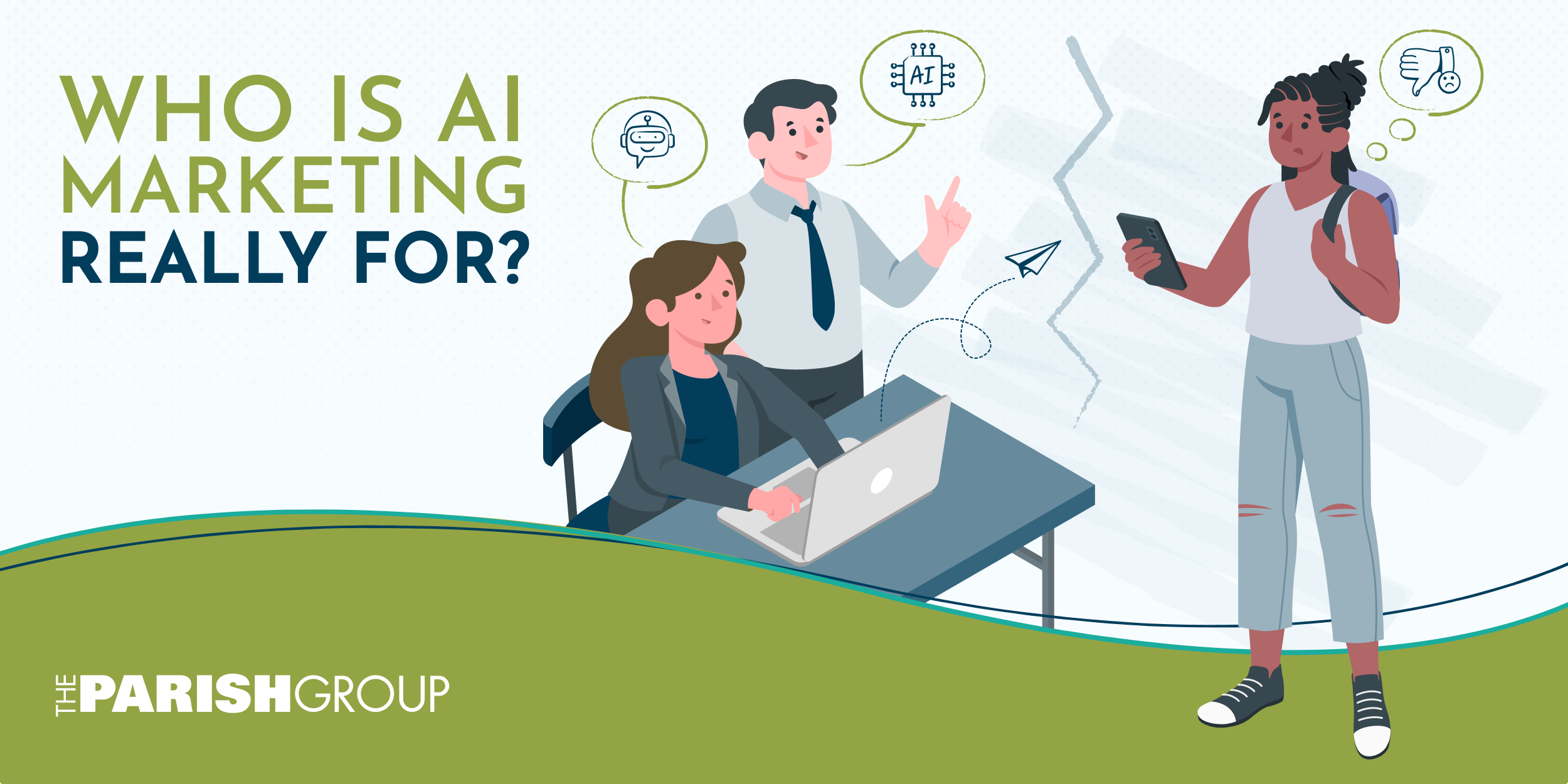
At The Parish Group, we’ve been thinking a lot about AI marketing and who it’s ultimately for.
Much of the conversation around AI has focused on efficiency—how quickly it can generate content, streamline workflows, or scale marketing efforts. And if we’re being frank, sometimes it feels like parts of those conversations are CEOs, CTOs, and CMOs trying to impress one another with their respective company’s innovations, because you know who’s conspicuously missing from those conversations? Audiences.
As AI tools become more embedded in everyday marketing practices, an important question is emerging: who is AI marketing really serving?
When organizations adopt new technologies without grounding them in audience needs, they risk losing sight of the people they’re trying to reach. Audiences—especially digital-native Gen Z audiences—aren’t sold on being marketed to by AI just yet.
AI Marketing in the Wild
Recently, an enrollment marketing email intended for prospective students came across our inboxes. The email touted small class sizes, faculty mentorship, and a robust campus community. It even asked the receivers to tell the unnamed sender about their interests.
Below the email’s CTA, there was a disclaimer noting that the email had been generated with the help of AI, that AI sometimes produces inaccurate content, and that talking with a member of staff is ideal for making an actual enrollment choice.
Now, kudos to this organization for being transparent about its use of AI. Truly. Research consistently shows that audiences want to know when AI is used in marketing and communication, but unfortunately, it rarely happens.
That said, when we thought about who this email was intended for—Gen Z high school students—it made us think about how much AI use highlights something that The Parish Group AVP of Partner Development, Roger Jones, just wrote about in his piece, How Higher Ed CMOs Risk Losing Sight of Their Audience: how easy it is for organizations to lose sight of audience wants and needs, especially in lieu of admittedly exciting technological advances.
The Growing AI Disconnect Between Leadership, Implementation, and Audiences
“Many higher ed CMOs are drifting (unintentionally) away from a deep understanding of their prospective students,” Roger writes, but throughout his argument, he hits on something bigger here—this disconnect extends beyond higher education and into executives’ understanding of how audiences perceive AI use.
That disconnect doesn’t just exist between institutions and audiences. It also exists internally, between leadership expectations and on-the-ground execution.
- A Harvard Business Review survey found a stark perception gap: 56% of executives believe their organizations are adopting AI faster than competitors, while only 28% of managers agree.
- April 2026 Gallup data found a similar gap: while 44% of employees say their organization has begun integrating AI, only 22% say there is a clear strategy in place.
Social media consultant Rachel Karten touched on this—the disparity between the performative AI use, if you will, that many executives want, and actual strategy—in a Substack post titled “Does your boss have AI brain?, where she spoke to marketers being asked to implement as much AI as possible.
“Right now the adoption of AI on marketing teams feels more like a scramble than a strategy,” Karten writes, “a race to be the first without thinking of the ramifications. One person shared, ‘There has been no official training, guidance, or even guardrails for how we are expected to use or adopt AI tools, just a directive that we should be doing it as much as possible.’”
When marketing becomes more about tools and trends, it stops being marketing. It’s production. Marketing involves courting an audience rather than treating them like an afterthought.
“Understanding your audience isn’t just a marketing function,” Roger wrote in his blog, “it’s an institutional responsibility. And effective marketing doesn’t begin with a campaign. Campaigns are a byproduct of understanding your audience.”
Today’s audiences—especially digital natives—are more discerning than ever, and they’re quick to notice when messaging feels automated or impersonal.
AI Marketing Can Erode Brand Trust
There’s an aptly titled Forbes piece, 55% of Audiences Are Skeptical of AI, Are Brands Listening?, highlighting the disconnect between companies jumping fully onto the AI bandwagon and audiences feeling uncomfortable when confronted with images and content they even think could be AI, including a thoughtful exploration of how diverse customer bases’ bias concerns—”55% of Black respondents express concerns about bias and stereotypes in AI-generated content, underscoring how AI often misses cultural nuances,” the article reports.
And in April of 2026, YouGov released their Trust in the Age of Generative AI report, “tracking consumer perception, trust, and the demand for transparency in 2026.” They found that:
- 51% of respondents said they were not excited about a future with more generative AI.
- 52% of respondents are generally uncomfortable with AI-generated writing.
- 49% of respondents said their trust in a brand would decline if they knew it replaced human creators with AI.
“The data points to the generative AI revolution not just being a technological shift; it is a potential trust challenge,” YouGov’s Global Head of PR and Editorial Andrew Farmer, said, “The findings in this report suggests that ultimately, the brands that succeed in the generative era may not simply be those that adopt AI fastest, but those that earn and maintain the trust of the audiences they serve.”
I asked Parish Group AVP of Marketing and Content Creation, Julia Watson Dozier, who’s been doing a lot of thoughtful thinking and writing about AI in higher ed admissions, about this disconnect between AI marketing and audience expectations.
“AI in enrollment management may be more efficient for the user, but not always for the audience,” she said. “Chatbots, for example, may save a counselor time, but talking with a human allows for nuance to be taken into consideration. Think about if the roles were reversed: how frustrating is it to talk to a robot when you really just want to talk with a human who can understand context better?”
Putting yourself in the shoes of the audience and flipping the roles is an astute point, and one that enrollment marketing and admissions teams should practice regularly. It’s especially pertinent considering what the YouGov report found about higher‑ed audiences: 80% of respondents aged 18–24 said they feel confident they could spot AI‑generated content, whether or not a company disclosed its use.
Why Gen Z is Particularly Wary of AI Marketing
Gen Z is both the most active user of AI tools and one of the most skeptical of AI-generated marketing.
While 51% of Gen Zers use generative AI weekly, anger about the technology’s ethics has risen, while excitement and hopefulness have dropped. Even among daily AI users, the prospect of more AI doesn’t excite them.
Returning to that earlier disconnect, there is a disparity between executives’ and Gen Z’s views on AI marketing. When asked, 84% of executives felt very or somewhat positive about AI-generated ads. Only 48% of Gen Z and Millennial consumers felt the same way.
So if Gen Z is actively using AI, why are they wary about it in advertising?
In 2025, marketing agency Major Tom produced a blog on Gen Z’s views on AI marketing, written by Chloe Yang and Avani Arora, their Gen Z interns, which we found particularly insightful.
“For Gen Z, the need for connection is higher than ever,” Yang and Avora write. “We don’t want content to just look good; we want content we feel a connection to…When content feels AI-generated, or an ad features a clearly artificial person, it immediately creates a sense of distance. It’s the difference between being spoken to and being spoken at. You can sense that it wasn’t written with the audience in mind, but rather pushed out for the sake of efficiency; that lack of care shows.”
Why This is Especially Pertinent in Higher-Ed Enrollment Marketing
School choice is one of the most personal, high-stakes decisions a young person makes, one that can shape the course of their life and career. Because of that, the way higher-ed institutions communicate during the enrollment process matters. It should feel personal, thoughtful, and grounded in a genuine understanding of the student’s needs.
That expectation of personalization is something we’ve frequently discussed in our internal conversations. When students reach out to an institution—or respond to enrollment communications—they’re often hoping to connect with someone who understands their questions and respects their time. They want to trust the institution. A purely automated response can sometimes signal the opposite: efficiency is being prioritized over engagement.
Trust in this context is not built through a single interaction, but accumulated across multiple touchpoints. Students are constantly evaluating signals of credibility, fit, and care across every email, message, and interaction they receive. In that sense, trust is less about any one moment of communication and more about the consistency of the experience over time. When those signals feel aligned and intentional, confidence grows; when they feel fragmented or overly automated, doubt can begin to form.
There’s another layer at play in enrollment marketing that is often harder to quantify but just as important: belonging. Students aren’t only evaluating information about academics or campus life—they’re assessing whether they can see themselves in that environment. Communications that feel overly automated or impersonal can unintentionally weaken that sense of belonging the second it’s detected. In contrast, messaging that feels attentive, responsive, and human helps reinforce the idea that a student is not just being recruited, but welcomed.
Don’t Ask “Can We?” Ask, “Should We?”
To be clear, this is not an argument against the use of AI in enrollment marketing. AI absolutely has a place in helping higher-ed institutions work more efficiently and communicate at scale. But intention is the key distinction. The real question is not whether we can use AI in our marketing, it’s whether doing so meaningfully improves the experience for the students and families we’re trying to reach.
“Obviously, we have to take into account what we can actually do on the institutional side, considering the massive volume we’re dealing with,” Julia told me. “Realistically, we must use technology to segment and personalize as much as possible for asynchronous communications (email sends, print, digital campaigns, etc.). For synchronous communications (1-on-1 convos via telephone or email, phone calls, virtual meetings, on campus visits), that’s when we really lean in and listen. Don’t tell them what makes the college/university a great place to learn. Tell them what makes the school the right educational choice for them.”
It’s about finding a balance. A strategic balance.
Enrollment marketing isn’t just about conveying information, but building a relationship with students at a moment when they are deciding where they belong. If AI is used in ways that feel impersonal, opaque, or dismissive of students’ time and expectations, it risks undermining that relationship before it even begins.
Which brings us back to the question we raised earlier: who is AI marketing really for? We feel like it’s a question marketers and executives should be asking themselves regularly these days.
Effective marketing—AI-enabled or not—shouldn’t begin with tools, trends, or initiatives. It begins with audiences.
For more insights into how (and why) marketers should vigilantly keep up an audience-first approach, check Roger Jones’s How Higher Ed CMOs Risk Losing Sight of Their Audience.