The conversation around artificial intelligence (AI) on college campuses has grown louder over the past few years. Some institutions have embraced it enthusiastically. Others remain cautious, unsure how it fits into their strategy. And in some cases, the response has been outright bans of something that still feels largely unknown.
But regardless of where a campus currently stands, one thing is clear: AI is here.
Much of the conversation so far has focused on how institutions themselves might use AI—whether to streamline internal processes, analyze data more efficiently, or assist with content creation. These are important discussions, but they are largely centered on the institutional perspective: How will we use AI?
There’s another question that deserves equal attention: How are prospective students already using AI?
AI Reshapes the College Search
It’s difficult to miss the growing number of reports, surveys, and think pieces documenting how dramatically prospective student search behavior has changed. What used to begin with a Google search increasingly starts with something different: a generative AI platform.
Students are asking tools like ChatGPT, Perplexity, or AI-powered search engines questions such as:
- “What are the best colleges for psychology in the Midwest?”
- “Which universities offer strong internships for marketing majors?”
- “What are affordable private colleges with strong career outcomes?”
These are not just quick searches. They are complex, conversational questions designed to narrow a student’s list and help them storyboard their college journey.
This shift represents an enormous opportunity, but also a significant risk, for colleges and universities.
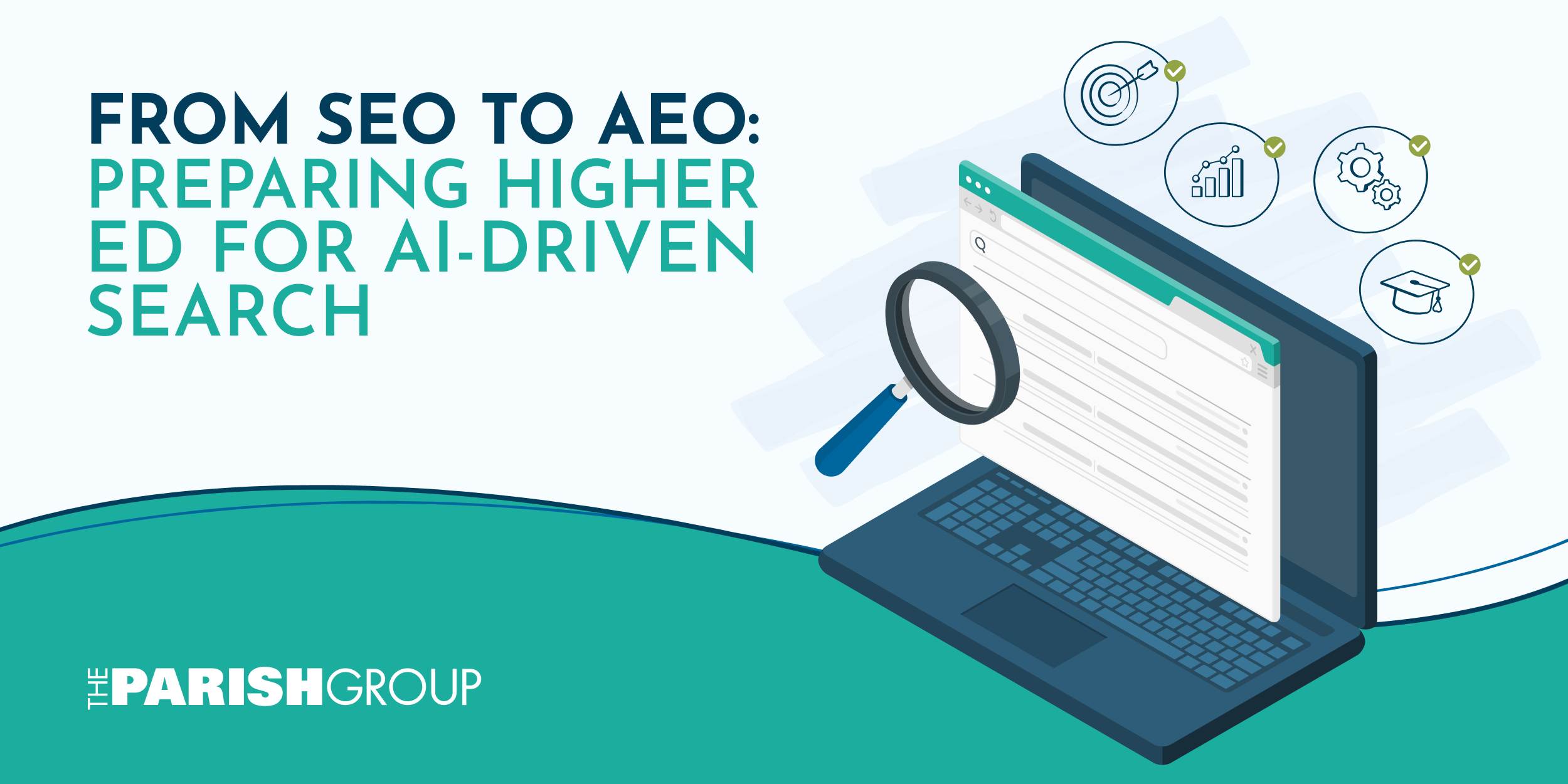
As more students rely on AI to understand their options, institutions can no longer rely solely on traditional Search Engine Optimization (SEO) to remain visible.
The Rise of AEO: Becoming the Answer
For years, higher education marketers have focused on ranking well in traditional search results. The goal was simple: appear as high as possible on a search engine results page.
But AI-driven search changes the game.
Instead of presenting users with a list of links, generative platforms often synthesize an answer directly. That means institutions are no longer just competing to be on the list. They are competing to be the answer itself.
This is where Answer Engine Optimization (AEO) becomes essential.
AEO focuses on structuring content so it clearly and directly answers the questions prospective students ask. That means building webpages and program descriptions that include:
- Clear, concise explanations
- Frequently asked questions
- Structured content that machines can interpret easily
- Authoritative information about outcomes, affordability, and career pathways
If your website isn’t organized in a way that allows AI tools to easily interpret and extract these answers, those platforms will simply source information elsewhere.
And those sources may (or may not) represent your institution accurately.
In that sense, AEO is about maintaining control of your narrative by ensuring your expertise is both visible and machine-readable.
GEO: Optimizing for Generative Search Ecosystems
While AEO focuses on answering questions clearly, Generative Engine Optimization (GEO) expands the strategy further.
Generative AI tools rarely rely on a single source. Instead, they synthesize information from across the internet to produce a summary response.
That means institutions must optimize their entire digital ecosystem, not just individual webpages.
GEO requires alignment across multiple areas:
- Institutional website content
- CRM and email communication strategies
- Digital advertising campaigns
- Earned media coverage
- Institutional profiles and knowledge panels
- Third-party rankings and program listings
Consistency matters. If generative engines encounter conflicting information about your programs, outcomes, or institutional positioning, the resulting summaries may misrepresent your institution or exclude it entirely.
For colleges and universities, that risk should feel urgent.
Why Waiting Isn’t an Option
Over the course of three decades working in higher education, I’ve watched several major digital shifts unfold, from the rise of institutional websites to the emergence of social media to the dominance of mobile-first design.
Each transformation reshaped how prospective students discovered and evaluated colleges.
But the adoption curve for AI-driven search is moving faster than anything we’ve seen before.
Waiting until website traffic drops or inquiry flow softens places your institution in a reactive position. By the time those signals appear, the landscape may already have shifted.
Institutions that begin implementing AEO and GEO strategies now position themselves ahead of that curve. They’re building authority, clarifying their institutional narrative, and ensuring their programs appear accurately within AI-generated search results.
The Next Step for Higher Ed Leaders
The question facing higher education is no longer whether AI will shape the college search process. It already is.
The real question is whether institutions will proactively adapt their digital strategies or scramble to catch up later.
If your campus hasn’t started exploring AEO and GEO, now is the time to begin that conversation.
Because in the next generation of search, visibility won’t just depend on where you rank. It will depend on whether AI knows how to find and accurately represent you at all.
Are you ready to have a conversation about your institution’s AI strategies, or lack thereof? The Parish Group is happy to help you navigate what your next steps should be.
Reach out at success@parishgroup.com or call us at 828.505.3000. Alternatively, you can set up a conversation with me directly. Here is my calendar link.