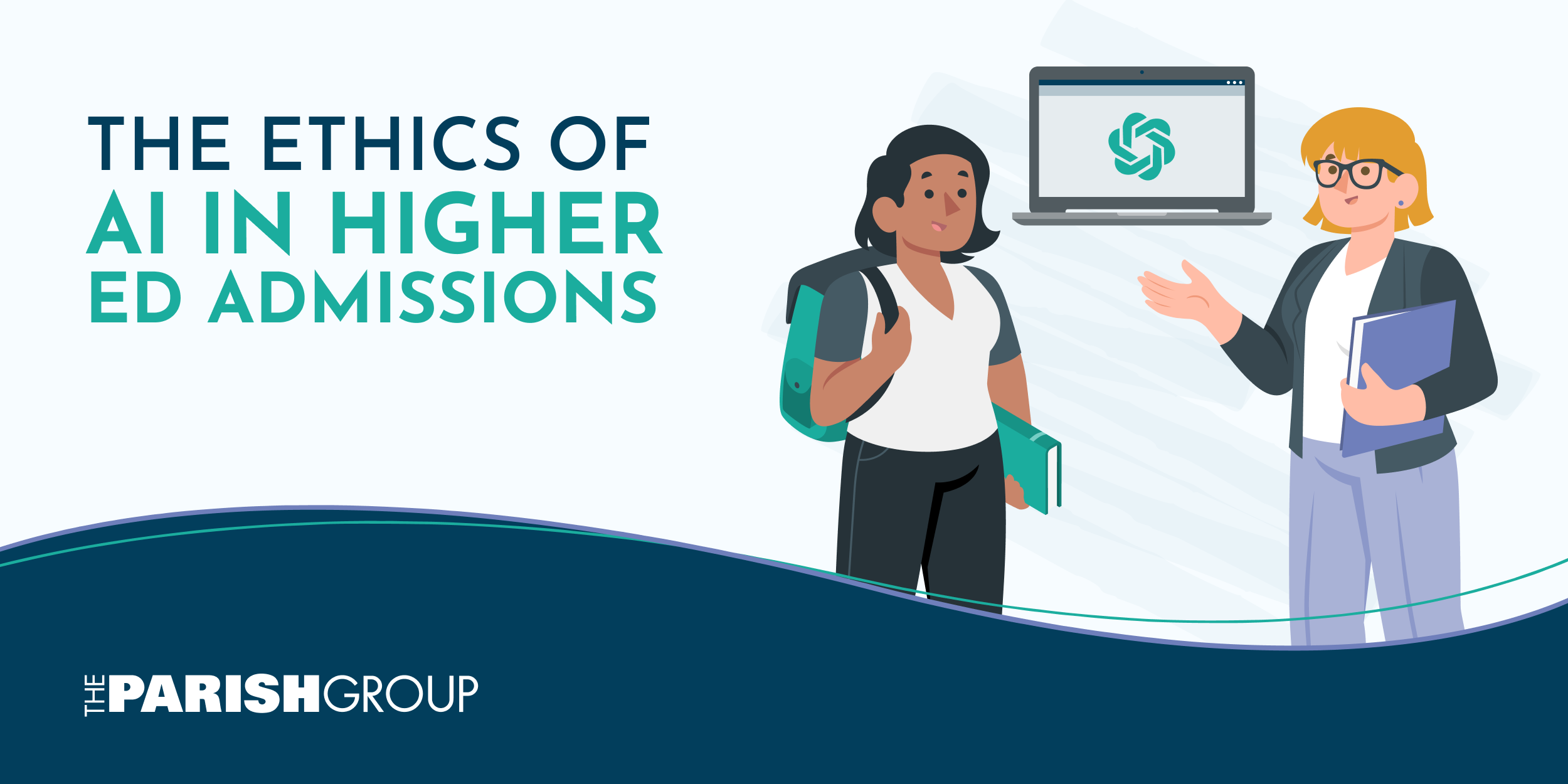
Artificial intelligence has quietly embedded itself into nearly every corner of higher education. Admissions offices use AI to power chatbots, predict enrollment behavior, personalize outreach, and streamline application review. At the same time, many institutions maintain strict policies penalizing students for using AI to assist with personal statements or application essays.
This contradiction raises an uncomfortable but necessary question: How can colleges restrict student use of AI while simultaneously building AI-driven admissions ecosystems?
The answer isn’t simple. And it shouldn’t be. The ethics of AI in admissions live in a gray area: one that requires clarity, consistency, and intentional dialogue rather than blanket approval or outright rejection.
The Double Standard: AI for Me, Not for Thee
Today’s applicants are digitally fluent. They understand automation, algorithms, and machine learning. When students are told that using AI for essay brainstorming is unethical, but then interact with AI-powered portals, chatbots, and CRM workflows throughout the admissions process, the disconnect is obvious.
From a student perspective, the message can feel inconsistent: AI is acceptable when it increases institutional efficiency. AI is unacceptable when it helps a student articulate their story.
This doesn’t mean student essays should be written by machines; but it does mean institutions must clearly articulate why certain uses are prohibited while others are embraced.
AI as an Efficiency Tool vs. AI as an Authenticity Threat
Admissions teams often justify the use of AI as a way to manage workload. AI tools can help them answer routine questions instantly, flag incomplete applications, predict enrollment behavior, and help personalize communications across thousands of prospects.
And this is generally framed as operational support, not decision-making replacements.
But when students use AI for their college application, it’s viewed through a different lens. With essays demonstrating their voice, self-reflection, and journey, the concern is that AI could obscure authenticity.
But keep in mind, students have a workload to manage as well. Most likely, they’re applying to multiple colleges and universities on top of keeping up with school work, extracurriculars, family obligations, part-time jobs, and more.
One could argue that older generations managed just fine applying to college without AI, but the landscape has become much more competitive from the student perspective.
Therefore ethics become a bit blurry when institutions fail to acknowledge that both sides leverage the same technology, just in different ways. Some colleges even use AI to review application essays conversely enough.
One of the biggest ethical gaps in AI isn’t whether it’s used, but how openly it’s acknowledged. Students are rarely told whether the email they just received was written by AI, if their engagement is being scored or analyzed, or how predictive models influence outreach and priorities.
If institutions expect honesty and originality from applicants, there is a reciprocal responsibility to be transparent about the technologies drastically shaping the admissions experience.
Policies With Nuance and Where to Place Boundaries
Many institutional AI policies are reactive, vague, or overly punitive. “No AI use” is easier to enforce than nuanced guidelines of course, but it doesn’t reflect reality and where we’re headed as a society.
The job market has seen a boom of companies wanting applicants with AI experience and skillsets. It’s almost reminiscent of math classes of old, where you had to solve equations sans calculator. While it is important to develop that ability, how many of us use calculators on a daily basis for quick math?
Students are already using AI to brainstorm, outline, check grammar, and better understand prompts (and yes, we recognize there is the occasional egg using it to write everything). Similarly, admissions offices are using it to manage workflows and communications.
The question isn’t whether AI belongs in admissions, but where the boundaries should be drawn and why.
There needs to be an alignment between institutional practice and student expectation. That could mean:
- Defining acceptance and unacceptable uses of AI for applicants
- Being transparent about institutional AI tools and their purpose
- Ensuring human oversight remains central to evaluation and decision-making
- Revisiting these policies regularly as technology and student behavior evolves
The goal isn’t perfection. It’s consistency, clarity, and trust.
The Bottom Line with AI, Admissions, and Applicants
AI is neither the villain nor the savior of admissions. But ethical misalignment, where institutions quietly embrace AI while publicly condemning its use by students, risks eroding credibility at a time when trust in higher education is already fragile.
If institutions want students to engage authentically, they must be willing to do the same. In the coming weeks, we’ll dive into the next evolution of AI in admissions: the virtual AI counselor.
Want to discuss strategy and approach to utilizing AI in your admissions process? We are here to help! Reach out at sucesss@parishgroup.com or call us at 828-505-3000.