We’ve Entered the Era of Visual Skepticism
In May of 2026, an enterprising X user posted a real Claude Monet painting online and wrote, “I just generated an image in the style of a Monet painting using AI. Please describe, in as much detail as possible, what makes this inferior to a real Monet painting.”
Almost immediately, people began confidently identifying all the supposed signs of artificial intelligence: the texture looked “too smooth,” the composition felt “off,” the details seemed “synthetic.”
But again, it was a real Monet.
What could be viewed as simply a funny internet moment should be a wake-up call to anyone in the marketing industry: audiences are increasingly primed to question the authenticity of imagery itself. They increasingly assume AI-generated content is everywhere.
According to a recent CNET survey, 94% of Americans believe they regularly encounter content that was created or altered by AI. At the same time (as the X gag reflected), only 44% say they’re actually confident they can distinguish real imagery from AI-generated visuals.
That said, 72% of U.S. adults said they will take some sort of action to determine if suspected AI imagery is real, with 60% saying they’ll closely inspect it for visual cues or the dreaded “AI tell.”
That fact could pose a challenge for higher education institutions looking to scale their imagery with AI, especially since 84% of Gen Z—currently their target audience— will investigate whether suspected AI imagery is real. It doesn’t matter if it is or not. It just matters that they suspect it.
In one widely discussed Reddit thread, a marketer targeting Gen Z consumers reported a significant drop in ad performance after replacing real lifestyle photography with AI-generated imagery. The images themselves reportedly looked polished and technically competent. But engagement still declined.
Enrollment marketing relies heavily on emotional trust. Prospective students aren’t just evaluating whether a campus looks appealing online. They’re evaluating whether they can imagine themselves there, and whether they trust the institution presenting it.
In many ways, AI-generated visuals risk becoming the next evolution of stock photography: technically polished, broadly appealing, and emotionally generic.
Ironically, in a world where generating images is easier than ever, authentic campus photography is becoming more valuable, not less.
AI-Assisted Imagery Isn’t Necessarily the Problem: Strategy-Free AI-Assisted Imagery Is
To be clear, this is not an argument against AI assistance.
Higher education marketing teams are under enormous pressure to produce more content across more platforms with increasingly limited time and resources. AI tools can absolutely play useful roles within creative workflows, whether through concept visualization, internal brainstorming, accessibility support, or campaign planning.
The problem emerges when institutions mistake content generation for strategy.
Because the issue isn’t whether AI can generate imagery. It clearly can. The issue is whether the imagery communicates something meaningful and institutionally specific, a distinction that’s becoming increasingly important as audiences grow more skeptical of generic content online.
Canva’s 2026 State of Marketing and AI Report found that while AI adoption among marketers is now nearly universal, consumers still overwhelmingly prefer advertising that feels guided by human intention. Mentions of “AI slop” have risen dramatically online over the past year (AI “slop” was Merriam-Webster’s Word of the Year in 2025), reflecting growing frustration not necessarily with AI itself, but with content that feels emotionally detached, interchangeable, or over-optimized.
Consumers are often more accepting of AI-generated imagery in obviously fictional or conceptual contexts: surreal campaigns, stylized graphics, or intentionally playful visuals, but acceptance rates drop significantly when AI imagery is used to represent real-world experiences or products people are expected to trust.
And while consumers are increasingly skeptical of AI-generated content, they aren’t anti-AI per se. Whether they’re able to articulate it or not, they’re skeptical of using it just to use it—they’re tired of seeing organizations using it without strategy.
Strategic use of AI in higher education marketing might involve helping a creative team storyboard a campaign more quickly, visualize concepts before a shoot, or adapt photographic assets across formats and channels.
Using AI without a strategy would look like generating thousands of less-than-stellar AI images of your campus, when photography could generate a hundred dynamic ones.
Specificity Drives Connection
One of the more interesting findings from recent AI advertising research is that consumers don’t necessarily reject AI-generated imagery simply because it looks obviously fake.
Instead, the imagery often struggles because it feels emotionally generic.
A recent Ipsos study (in collaboration with Syracuse University’s S.I. Newhouse School of Public Communications) comparing human-created and AI-generated advertisements found that AI content generally performed adequately in terms of baseline credibility (an article promoting the study is titled “AI Ads Are Good Enough and That’s The Problem”). But it consistently underperformed in emotional engagement and memorability. As the report succinctly states: “credible is not the same as compelling.”
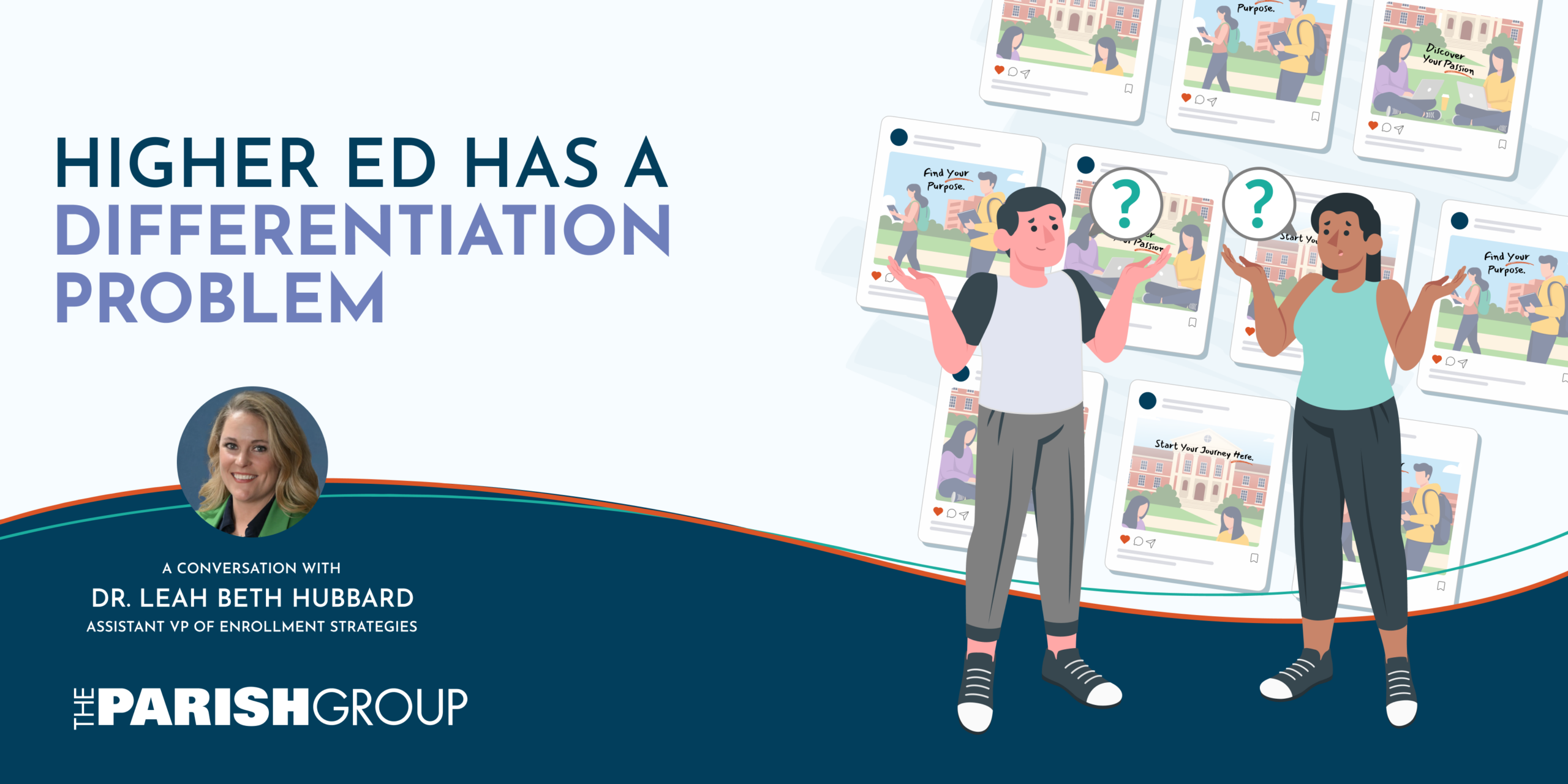
AI is already very capable of generating beautiful campus imagery in the abstract. Smiling students. Sunny quads. Diverse classrooms. Tree-lined walkways. Aspirational college moments. But many institutions were already struggling with visual sameness long before generative AI entered the conversation. Higher education marketing has historically gravitated toward many of the same visual cues, emotional beats, and aspirational aesthetics—AI simply makes those conventions easier to reproduce at scale.
AI cannot recreate the exhausted-but-proud expression of a student leaving a late-night studio or study session. It can’t showcase the specific joy of your campus quad on the first glorious day of spring or capture the idiosyncrasies and nuances of a weird legacy holiday that only your campus celebrates.
The look a professor gives a student they taught for three semesters absolutely nail a presentation? Countless office hours built that pride. The bittersweet expression between two students who started freshman year as frosty roommates and are now walking across the graduation stage as best friends? Four years created that moment.
In enrollment marketing, those details matter. It’s the details only your campus can create that tell your story. The specificity is the sale.
Distinctiveness Is Becoming More Valuable
We couldn’t disagree more.
While AI is unquestionably reshaping how marketing and creative teams work, that prediction assumes the primary goal of marketing is simply content production. But the most effective marketing has never merely been about producing content at scale. It’s about creating emotional resonance, distinctiveness, and connection.
And real-time consumer data suggests audiences still value those qualities.
As synthetic imagery becomes easier and cheaper to produce, institutions may find themselves competing less on visual polish and more on emotional specificity. The schools that stand out will not necessarily be the ones generating the highest volume of content or adopting AI tools the fastest. They will be the ones who can visually communicate a genuine sense of place, personality, and lived student experience.
Because in an increasingly synthetic media environment, distinctiveness becomes more valuable.
Remember, the goal of campus photography isn’t simply to show students a campus. It’s to help them recognize yours.
As campus imagery becomes easier to generate, authentic visual storytelling becomes more important to get right. Explore The Parish Group’s photography solutions to see how we help institutions create photography that communicates a genuine sense of place, personality, and student experience.