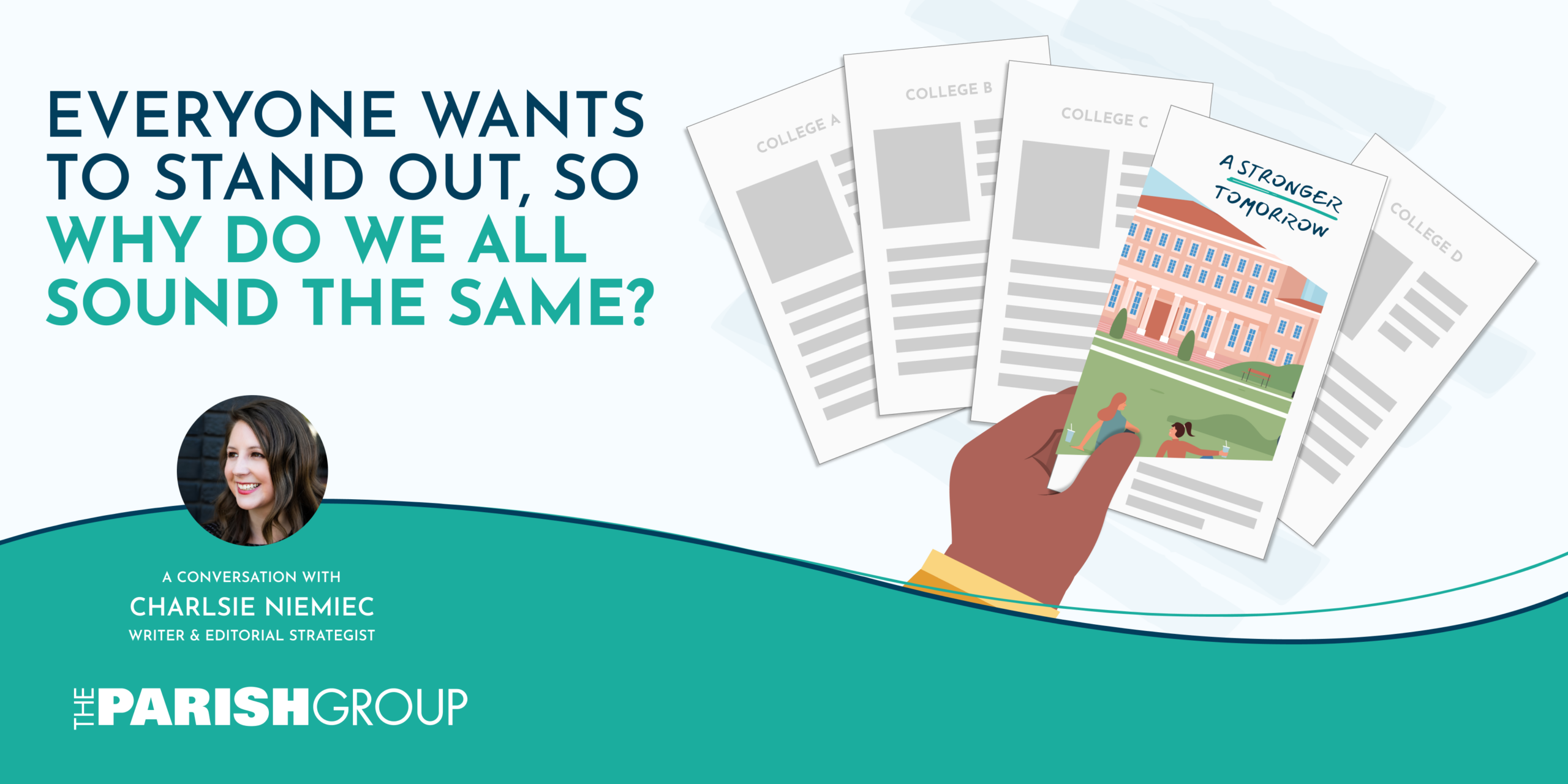
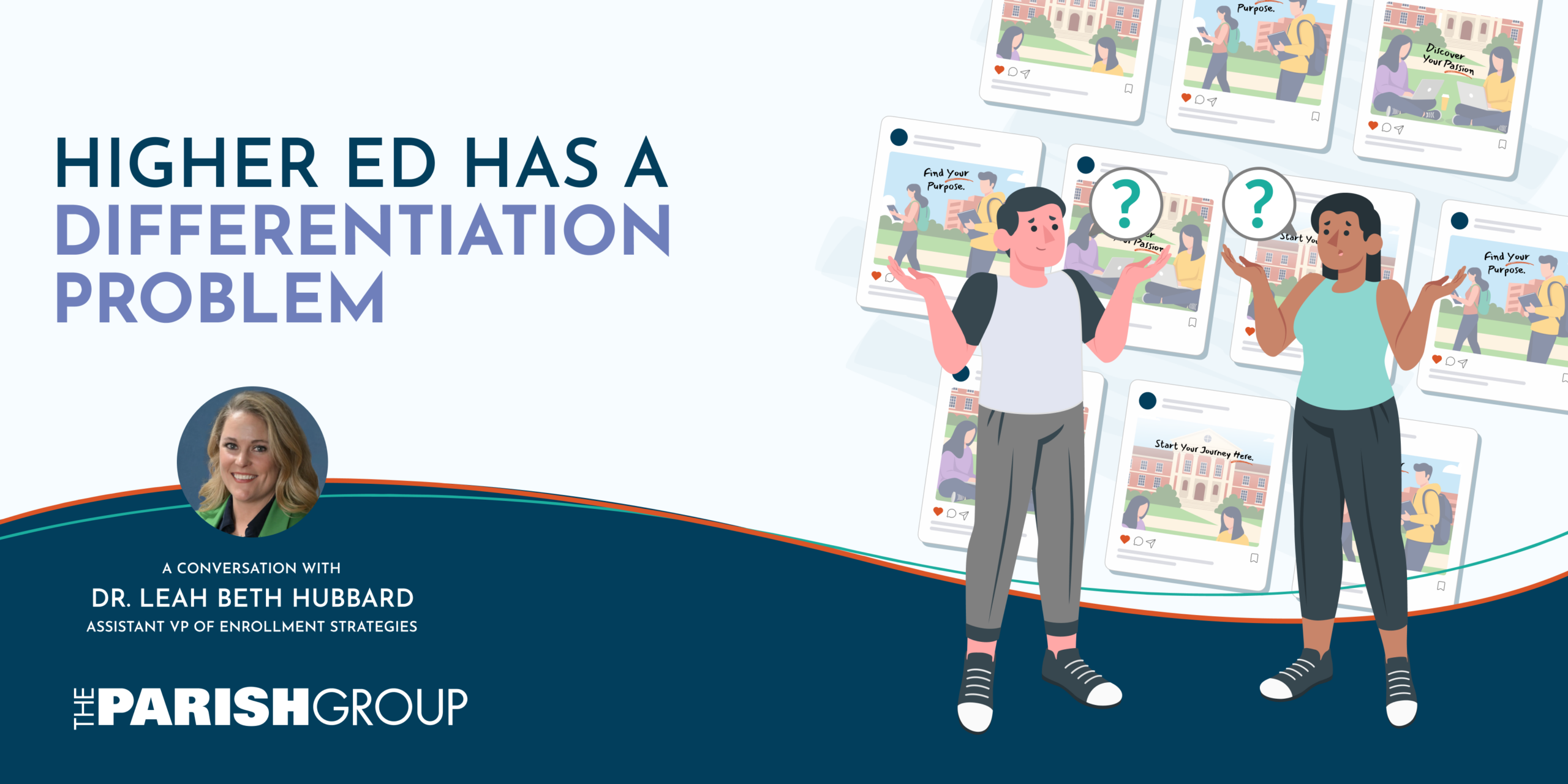
If you spend enough time perusing higher ed marketing as I do (and probably if you are just a casual peruser), you’ll start to notice a lot of similarities:
- Find your purpose.
- Discover your passion.
- Join a community.
- Get hands-on experience.
- Prepare for your future.
- Start your journey.
Etc., etc.
Now, there’s nothing inherently wrong with any of these ideas, and institutions use them because, in many ways, they’ve historically worked. And most colleges and universities making these promises probably deliver on them in some way.
But we’re reaching the point where it feels like colleges and universities are all saying the same thing, at a time when they need to differentiate themselves more than ever.
This isn’t a new phenomenon by any means. Back in 2015, a joint Gallup and Inside Higher Ed study asked university presidents to describe their institution’s purpose in three words or phrases. Nearly 60% of the responses fell into just three broad categories: educating students, preparing them for the future, or transforming their lives. A year later, Inside Higher Ed wrote about the similarity of college brands, pointing to taglines like “Start here. Go anywhere,” “Start here. Get there,” and “Going anywhere starts here!”—”To sell themselves, colleges try to stand out. But often, their marketing efforts look practically identical,” the piece by Ellen Wexler begins.
And now, here we are in 2026, having the same conversation.
That matters because the pressures facing colleges have changed. Families are asking harder questions about cost and return on investment. Institutions are competing for fewer traditional-aged students. Colleges are closing. Students have more ways to compare their options (today’s crop of prospective college students have never been savvier consumers of advertising and marketing efforts as they are today).
In our current environment, telling a prospective student that you’ll help them “find their purpose” isn’t enough. They need to know what that actually means at your institution.
The good news? While higher ed 100% has a differentiation problem, I don’t think the root is that they have nothing that sets them apart. I think they’ve just been conditioned to be very good at taking the things that make institutions distinctive and talking about them in ways that make them sound similar. We can undo conditioning, though.
Your College Might Not Be That Different—and That’s Okay
Despite what I just wrote above (and I do believe that all institutions can find differentiators!), here’s a hard truth that makes higher ed marketers and leadership uncomfortable: more often than not, your institution isn’t that unique.
That’s okay. It happens in most fields. There’s an argument to be made that Nike (don’t come for me, sneakerheads!) isn’t that much more unique than other sneakers. Coke and Pepsi are both behemoths of similar variety. And at their core, higher ed marketing groups—including us here at The Parish Group—are similar to our competitors because we’re all trying to do the same thing.
Likewise, higher education institutions have the same business goals. They educate students. They offer majors. They have faculty, clubs, internships, advising, residence halls, and career services. Many offer study abroad. Many have beautiful campuses. Many can point to successful alums.
Sometimes I think we get so hung up on finding the one thing nobody else can claim that we miss much better differentiators sitting right in front of us. And we often overlook that differentiators don’t have to be exclusive to your institution.
Differentiation doesn’t require exclusivity. It requires specificity.
And often, it’s the combination of specific things that becomes the unique selling point.
Let’s look at my alma mater, Queens University of Charlotte, for example. Internships aren’t unique to Queens. Neither is study abroad. And plenty of colleges can talk about the advantages of attending school in a rapidly growing city. But bring those things together—the internship experience, study abroad opportunities, and access to one of the fastest-growing cities in the country—and you begin to tell a much more specific story about what a Queens education looks like.
The question isn’t always, “Are we the only college doing this?”
A better question might be, “Are we explaining why the way we do it matters?”
Stop Asking, “What Makes Us Unique?”
This may sound like I’m repeating what I wrote above, but stick with me. It’s important.
I’ve been part of enough branding conversations to know what happens when you walk into a room and ask people what makes their college special.
- “Our community.”
- “Our people.”
- “Our faculty really care.”
- “Students feel like they belong here.”
It’s the same as above, because we are used to parroting these talking points and value-adds.
And I think it’s often because the question being asked isn’t specific enough to yield anything other than generic answers. We need to be asking “why?” more.
- Why does your community feel different?
- What makes the people special?
- How specifically does this faculty show they care?
- Why do students feel like they belong?
And pushing further with “Why?” opens the door to more in-depth conversation that actually gets us someplace. Open-ended questions are your friends here:
- How do your students interact with faculty?
- What are some highlights of students’ first year?
- What kind of conversations about the university are students having? The good and the bad?
- What would students say we can improve on?
- What’s something that happens in 75% of your courses?
- What are some advantages your students have because of where you’re located?
And then keep asking questions.
“Hands-on learning” is a perfect example of where digging deeper gets specific, valuable attributes. We’ve used that phrase so often in higher education that we’ve turned something that could represent real value into a buzzword.
What does your hands-on learning look like? How do students get real-world experience?
- Are nursing students working with patients earlier than they would elsewhere?
- Are business students consulting with local companies?
- Are environmental science students collecting data in the mountains surrounding campus?
- Does every student complete an internship?
- Are faculty bringing their own research into undergraduate courses?
The same applies to “purpose.”
Maybe your institution has a first-year experience designed to help students identify their strengths and connect them with possible vocations. Maybe those conversations continue through advising, coursework, internships, and career preparation. Now we’re no longer talking vaguely about helping students “find their purpose.” We’re explaining the process through which you help them do it.
Start Asking What You’re Doing Right
This is also why anyone coming into an institution to lead change—whether that’s a new president, CMO, consultant, or agency—needs to listen before judging. When you’re looking for what’s wrong, you can easily overlook what’s already working—and what might actually set the institution apart.
It’s easy to come in and identify everything wrong. It’s much harder to understand why people do things the way they do. Sometimes the process that looks strange from the outside is connected to the heart of the institution. Sometimes the thing someone wants to modernize is the thing students love. Sometimes what isn’t being said is more valuable than the answer to “What makes you unique?”
Before deciding what needs to change, ask people how things work. Ask why they work that way. Ask students what matters to them.
The differentiator might already be there. You just haven’t learned how to talk about it yet.
If AI Makes Generic Higher Ed Content Easier, Specificity Becomes More Valuable
While higher ed’s sameness problem predates the AI boom, the proliferation of generative AI will both increase and highlight the issue.
Think of how easy it will be for multiple enrollment marketing departments to ask an AI tool to write copy about a close-knit college community where students discover their passions through hands-on learning while preparing for meaningful careers, and it can give you a perfectly serviceable paragraph in seconds.
AI makes it easier than ever to sound like a college. That makes it more important than ever to sound like your college. And the proliferation of sameness can actually work to your institution’s advantage, so my advice is to start taking advantage of it now.
I feel very confident saying that a college or university with a unique value-add and legitimately distinct POV will stand out now more than ever. And the increase in enrollment marketing content can even help you figure out how to stand out.
Look at what other institutions are generating. Sure, you may find that you have many of the same attributes and stories. But what do you have that they don’t? Everyone has something. That’s where your campaigns, messaging, and content should start. And, as we’ve already discussed, keep digging. Ask why. Ask for examples. Get specific.
We’re not necessarily anti-AI here at The Parish Group. It could be an incredible tool that helps human-strapped departments. But we’re already seeing it help folks take shortcuts, and shortcut-driven content is (and will continue to be) becoming the norm; the institutions that take the time and energy to dig deeper and excavate unique stories will have an advantage. When everyone has access to AI-generated sameness, the institutions that can articulate a genuinely distinctive story will stand out.
You Have to Live Your Differentiators
Here’s another possible unpopular truth. Marketing can’t fix a bad experience on its own. You have to actually do the things you’re telling students make you unique (this really highlights my philosophy that the whole campus is an enrollment opportunity).
If personalized support is a differentiator, students shouldn’t have to bounce between four offices to get a question answered. If you promise close faculty relationships, students need opportunities to build them. If experiential learning is part of your value proposition, it needs to be accessible to more than the students who know where to look.
That’s difficult in higher education, where different offices and departments have different priorities. Time to return to one of my favorite soapbox topics: Prospective students don’t experience your organizational chart—they experience your institution.
Own your mission. Own your values. Own your processes. Then make sure students experience what you promise.
That’s the biggest differentiator.