AI can create a pretty good ad.
That was one of the more surprising findings from a recent study, AI Ads Are Good Enough — And That’s the Problem, conducted by Ipsos and faculty from Syracuse University’s S.I. Newhouse School of Public Communications. Researchers compared existing human-created ads with fully AI-generated versions built from the same strategic briefs. Consumers largely couldn’t tell which was which—and the performance gap between them wasn’t enormous.
But there was a gap. Human-created ads still performed better, particularly when the work required emotion, humor, storytelling, or a genuine point of view.
We recently spoke with Carrie Riby, professor of practice in advertising at Newhouse and one of the researchers behind the study, about what those findings mean for marketers—and, specifically, what colleges and universities should consider as they incorporate AI into their own communications strategies.
We highly recommend reading our full conversation with Riby, but if you’re short on time, here are five takeaways we think higher education marketers (and higher ed leaders) should keep in mind.
5 Takeaways From Our Conversation With Carrie Riby About Her Study, “AI Ads Are Good Enough — And That’s the Problem,” and the Future of AI in Marketing and Advertising
AI Is Good at Efficiency. It’s Not as Good at Connection.
“AI is excellent for efficiency, but it still struggles to create real consumer connections,” Riby told us when we asked her where AI is proving effective for marketers, and where it’s still falling short.
AI isn’t uniformly bad at advertising. In fact, Riby said one of the most enlightening parts of the study was discovering just how good the AI-generated ads could be.
Where they performed particularly well, however, was on relatively straightforward, product-oriented advertising: there’s a problem, here’s the product, here’s how it solves it. Ask AI to create something that depends on humor, emotion, or human connection, however, and the gap becomes much more apparent.
That’s an important distinction for higher education.
Colleges and universities aren’t simply communicating features. They’re asking prospective students to imagine themselves on a campus, understand what makes an institution different, develop a sense of belonging, and ultimately make a deeply personal decision about where they’ll spend the next several years of their lives.
As The Parish Group’s AVP of Enrollment Strategies, Dr. Leah Beth Hubbard, points out, AI can also help marketers make sense of the stories they’re already collecting. A university may have hundreds of student stories, survey responses, testimonials, or other pieces of qualitative feedback that can be difficult for a small marketing team to synthesize on its own. AI can help identify recurring themes and surface commonalities across those stories.
As Hubbard puts it, AI can help “find the story in the stories”—but it shouldn’t be responsible for creating the story itself. The meaning, context, and human judgment still have to come from the people who know the institution and its students.
Efficiency has real value. But when connection is the objective, efficiency can’t be the only measure of success.
Better Strategy Produces Better AI.
One of the clearest findings from Riby’s research had less to do with the technology itself and more to do with what humans give it.
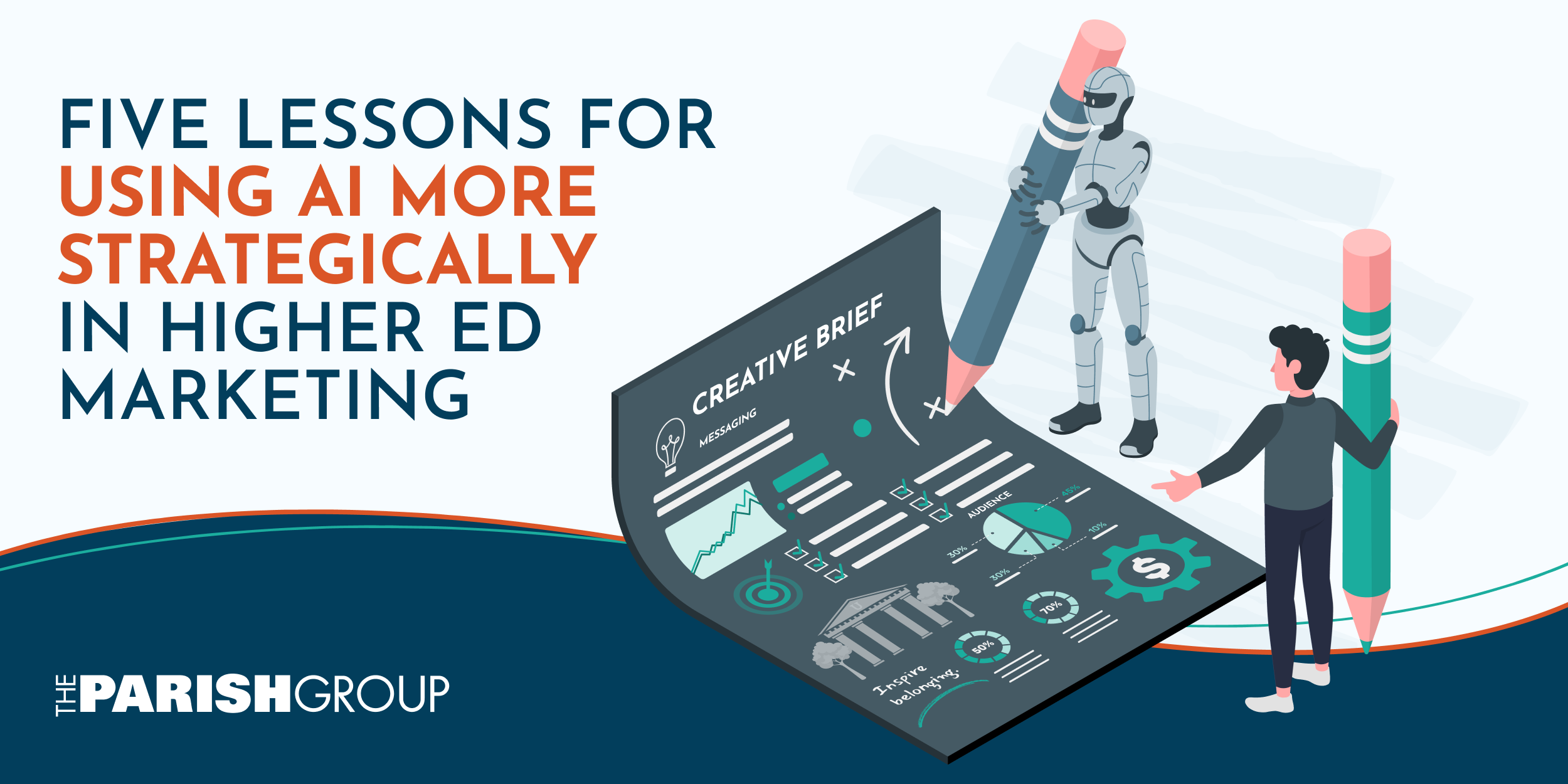
“The better the creative brief, the better the ad,” she told us.
For the study, AI-generated ads were developed from strategic briefs. And when the underlying strategy was strong, the resulting AI work tended to be stronger, too.
As Riby put it, “The strong strategy foundation is what made the difference.”
That’s an important reminder as organizations race to experiment with new tools. Using AI strategically doesn’t begin with opening a chatbot or image generator. It begins with knowing your audience, understanding your objective, developing the idea, and determining what you actually want the communication to accomplish.
AI can help execute a strategy. It isn’t a substitute for having one.
Use AI Where It Actually Has an Advantage.
When we asked Riby whether she’d use the AI-generated ads from the study if she were leading marketing or advertising for an organization, she answered affirmatively.
“I would use AI in ad creation without hesitation, especially if I need, for example, many kinds of ‘product’ ads matched to many specific markets,” she said.
This use case shows a thoughtful way to use AI in your marketing efforts. It’s not coming up with the strategy. It’s not coming up with the idea. It’s making various iterations on work you’ve already done.
This is particularly relevant for higher education, where teams may send hundreds of emails with essentially the same call to action over the course of an enrollment cycle. Once you’ve established the core messages that communicate who you are and what makes your institution distinctive, AI can help teams develop variations of that language for different audiences, programs, or stages of the enrollment journey—without requiring marketers to start from scratch every time.
It’s a much more productive way to think about AI than asking whether an organization should simply “use AI.”
Where does the technology solve an actual problem? Where can scale, customization, iteration, or efficiency make your team more effective? And where does the work require something humans are still better equipped to provide?
Not every communication needs AI. Not every communication needs to avoid it, either. The opportunity is figuring out where the tool actually adds value.
More Content Makes Brand Differentiation More Important
AI enables organizations to produce an enormous amount of content very quickly. But more content also means more opportunities to dilute the very thing that makes an institution recognizable.
Riby framed the tension simply: “There’s productivity, and there’s brand needs.”
She also offered a warning: “If there is no brand foundation or vision in place, AI can create bigger problems.”
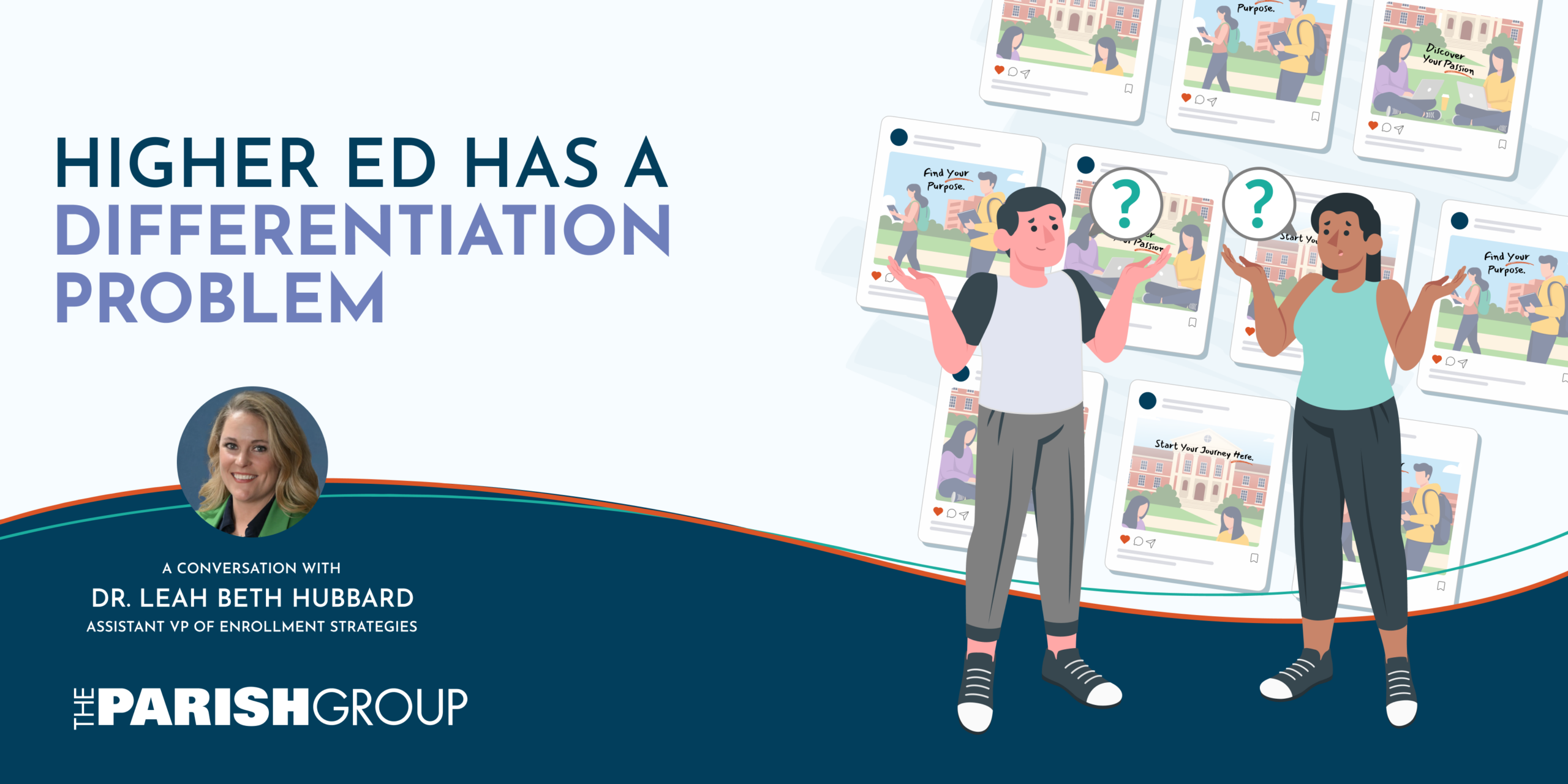
That risk is particularly significant in higher education, where differentiation is already a challenge. If institutions use the same tools to produce increasingly generic content, it becomes even easier for their messages to start sounding alike.
As The Parish Group’s SVP, Eric Bryan, puts it, “A distinctive brand has always been fundamental to creating a successful institution. With the industry’s rapid pace of AI adoption, it is all too easy to lean into the technology to create content under the guise of efficiency and cost-effectiveness.”
AI doesn’t create higher education’s differentiation problem, but it can make it easier to perpetuate. And when institutional messages begin to sound interchangeable, the things that help prospective students decide whether they can see themselves at an institution become even more important.
“Prospects and their families crave unique human stories, and a clearly defined campus culture and values allow them to picture themselves in the setting you create,” Bryan says.
That’s why human oversight matters as AI becomes more embedded in marketing workflows. Institutional voice, point of view, values, and personality shouldn’t become casualties of increased output.
In Higher Education, AI Is Also a Question of Trust.
The Ipsos/Newhouse research found that consumers aren’t particularly good at identifying whether an ad was created by AI. But that doesn’t necessarily mean organizations should conclude that disclosure and transparency don’t matter.
As Riby told us, “No one wants to feel duped by something that’s not human.”
And when we asked whether transparency may be particularly important for colleges and universities, she agreed:
“If you’re caught looking like you are trying to hide something, it’s going to come out negatively.”
AI can also make it easier to produce and distribute more content, but that efficiency can also lead to content being created without sufficient institutional context. That risk becomes even greater when AI makes it possible to generate and publish content quickly and at scale, without necessarily requiring the same level of coordination that would have gone into each piece individually.
The result can be a growing gap between what an institution is telling prospective students and what the people responsible for delivering that experience actually know.
As Dr. Leah Beth Hubbard puts it, “Your campus needs to know what you’re saying, too. There’s nothing more embarrassing than sending a message about something exciting happening at your institution, only to have a student reach out with a question and discover that no one on campus knows what they’re talking about.”
The question, then, isn’t simply whether students will notice that AI was involved. It’s whether the way an institution uses AI supports—or undermines—the relationship it’s trying to build with them.
Bonus: Good Marketing Is Still Good Marketing.
In the interest of keeping our full Q&A with Riby relatively succinct, we cut one exchange from the final version. But while putting together this summary, we realized her answer—brief as it was—might actually sum up much of our conversation.
We asked Riby whether, for all the ways AI is changing how marketers work, the fundamentals of good marketing and communication have actually changed.
Her answer was refreshingly brief: “No, it hasn’t changed at all.”
And looking back at the rest of our conversation, she made a pretty compelling case for it.
Because for all the conversations we’re having about AI—how to use it, where to use it, when to disclose it, and what it might mean for the future of our industry—the fundamentals Riby returned to throughout our conversation were remarkably familiar.
Know your audience. Have a strategy. Understand your brand. Create an emotional connection. Be authentic about who you are. Give people something worth paying attention to.
Interestingly, Riby isn’t the first expert we’ve spoken with recently to make essentially the same point.
In our recent conversation about marketing to Generation Alpha, McCrindle Managing Director Sophie Renton told us that strong strategy requires focusing not only on what is changing, but also on what remains unchanged. The tools we use to create trust, belonging, identity, and connection may evolve, but those underlying human needs don’t.
As Renton put it, “You innovate on the tools that implement that strategy.”
AI may be one of the most significant new tools marketers have encountered in years. But perhaps using it strategically starts with recognizing that the people we’re trying to reach haven’t suddenly stopped being people—and the institutions trying to reach them haven’t stopped being institutions. The mission, identity, experience, and distinctiveness of an institution still matter. The goal isn’t simply to use AI to reach more students; it’s to help the right students understand who you are and determine whether your institution is the right fit for them.