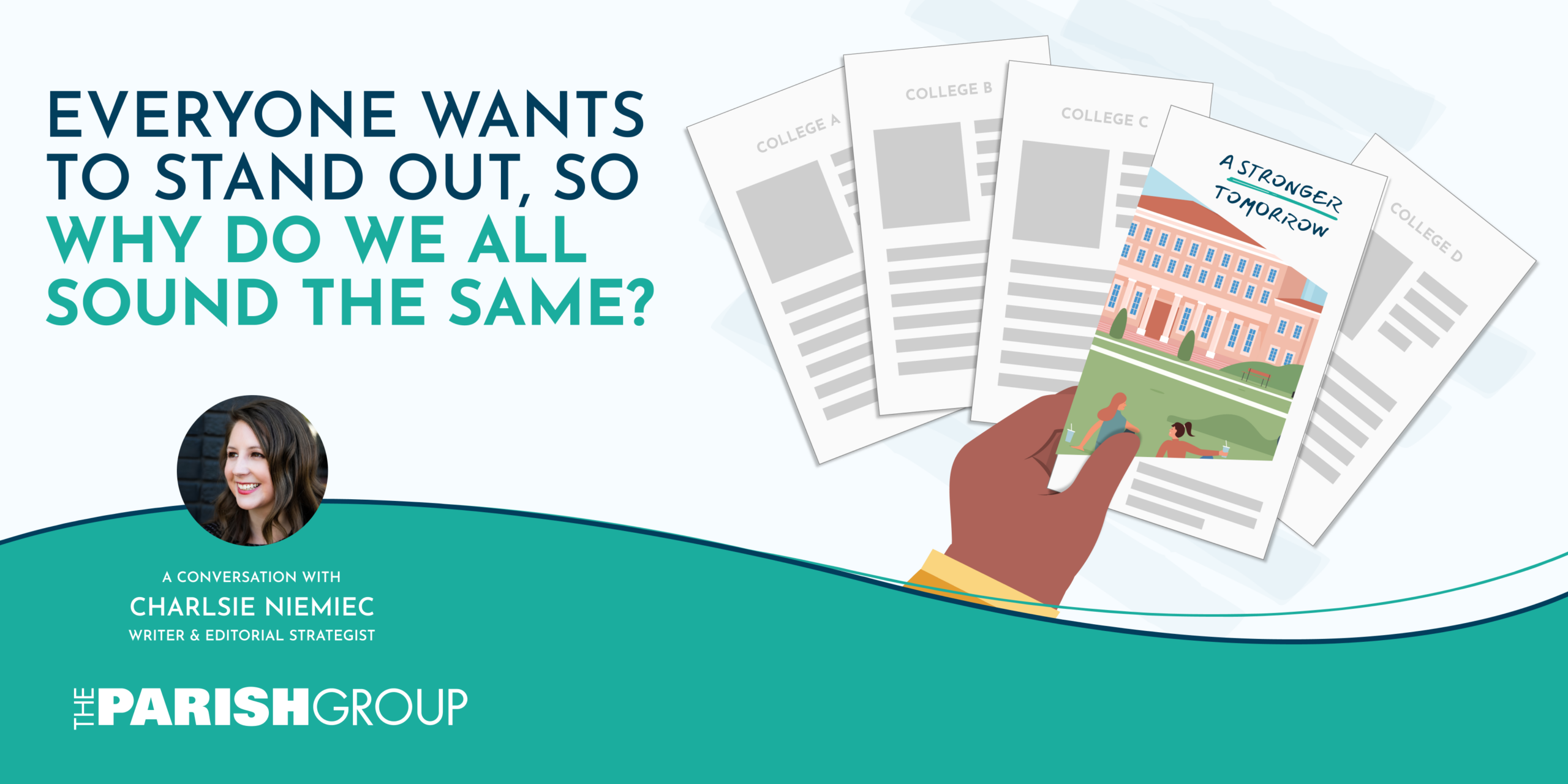
We spend a lot of time talking about higher education’s differentiation problem: colleges and universities spend a lot of time trying to articulate what makes them different, yet so much of the language they use to do it starts to sound remarkably similar.
It happened to be a beautiful coincidence that the same day we had another version of this conversation—wondering aloud whether or not you’d be able to tell branding apart if you took the names off of higher education institutes and lined them up—that Charlsie Niemiec’s LinkedIn post graced our feeds.
“I had more than 20 tabs open, each with a website for a writer, marketer, content studio, or small agency, and after a while, I couldn’t tell them apart,” Niemiec wrote. “Almost everyone promised some version of the same thing: a distinct point of view, an authentic voice, original ideas, and human storytelling. But the language kept changing while the websites remained remarkably familiar. ‘Different’ had somehow acquired a remarkably specific look.”
It was the kind of post that makes you stop scrolling because she was pointing out something that happens all the time, but is so often not said aloud.
Charlsie’s point is much bigger than website design or higher education. It’s a challenge that transcends industries. We’re constantly told to develop a distinct voice, establish a point of view, build a unique brand, and create content that stands out. Yet we’re also surrounded by templates, formulas, best practices, algorithms, and now AI tools designed to help us do exactly that. The result can be a strange paradox: the more we try to differentiate ourselves, the more alike we can become.
That paradox is precisely why we reached out to Niemiec. She’s a writer and editorial strategist we’ve been following on LinkedIn for a while, where she’s built a distinctive personal brand and voice, not by following a prescribed formula or courting the (ever-shifting) algorithm, but by paying close attention to what interests her, trusting her instincts, and allowing different parts of herself to show up in her work.
So, we asked Niemiec what it really takes to make something feel like your own: how to develop a point of view, trust your instincts, balance what works with what feels right, and resist the forces—from formulas and algorithms to AI—that can make perfectly competent content feel interchangeable.
Her answers are a compelling case for a simple idea: Maybe standing out isn’t about figuring out how to be different. Maybe it’s about figuring out what you actually have to say.
A Conversation With Charlsie Niemiec About Cultivating Distinction
TPG: Your post starts with the realization that you had 20+ tabs open and could barely tell the marketing websites apart. What do you think causes so many brands, businesses, and professionals to start sounding and looking the same?
CN: Fear, mostly. Marketing teams are under enormous pressure to prove that what they’re doing is working, so we look at competitors, benchmarks, industry research, whatever performed well six months ago. We spend so much time asking what works that we forget to ask whether the thing we’re making is any good.
TPG: We’re constantly told to develop a distinct voice and point of view, but the tools, templates, best practices, and formulas we’re given to help us do that can push us toward the same result. Why do you think that happens?
CN: I love a template. I’ll always take one gladly—it’s a great place to start. But you still have to make editorial judgments: what to keep, what to cut, what to push, and what to trust the audience to understand without being told.
Templates ship with someone else’s decisions already installed. The hook goes here, the CTA drops at the bottom, done before you’ve opened the doc. Scroll for 10 minutes, and you’ll catch the same “here’s what nobody tells you” hook, the same three-item list, the same bolded line doing the same job, the last line posing a question for the audience that’s been asked 300 times. Different names, same skeleton.
I’ve learned that developing judgment requires room to fail. Growth targets don’t leave much space to try something weird and get it wrong, so the template keeps winning. It’s rarely the best choice in the room.
TPG: In your LinkedIn post, you wrote that we love authenticity “in theory,” but that our appetite for it can be pretty limited. Why do you think people are drawn to originality but can become uncomfortable when someone actually pushes beyond the expected?
CN: Listen to how brands talk about authenticity, and the word turns to mush fast. Everyone’s supposed to want it. Ask five people to define it, and you’ll get five different versions that somehow all center back to “brand values.”
Much of the time, what we want is a familiar idea packaged in a new way. Real originality can ask you to reconsider a picture you’d already finished, and that’s a harder sell.
The internet doesn’t help. Scroll, mute, unfollow, tell the algorithm you’d like less of that, please—we’ve built entire systems for skipping the part where we sit with something. “I don’t like this” turns into “this is bad” somewhere around the second scroll.
I’ve gotten much more conscious of the space between those two reactions. Did I see something bad, or something I wouldn’t have done myself? Did it fail, or did it violate an expectation I didn’t realize I had? I think originality requires enough room to find out.
TPG: You’ve written about giving yourself permission to trust your own instincts and let your work get a little stranger. What changed when you stopped trying to make your work fit what you thought it was supposed to look like?
CN: This is funny to me because professionally, I am almost pathologically analytical. For a client, I want the research, the psychology, the cultural context, the stakeholder, what one tiny word might do to a human brain in that exact sentence.
My own writing cannot begin there. I had to stop intellectualizing every instinct before I let myself have it. Sometimes the first piece of evidence is the pit in my stomach or a little voice going, “Ooh, there’s something here.” I’ve published things that terrified me because they felt too true to unknow. That instinct isn’t coming from nowhere, either. There are years of writing, editing, researching, reading, and paying attention underneath it. I stopped requiring it to show me all its work before I trusted it.
I’ve learned not to pop those bubbles just because I can’t explain them yet. Follow the bubble, let it sit, look at it again in a different light. Sometimes the idea changed. Sometimes you did. This has become my whole approach to my own work, but I’d be lying if I said this is comfortable or easy.
TPG: You’ve built a recognizable voice on LinkedIn in a space where a lot of people are now trying to build a “personal brand.” What have you learned about developing a voice that actually feels like your own?
One of the stranger things about personal branding is watching people remove themselves from it.
There’s a recognizable Personal Brand Voice now: the lessons, the confessions, the same handful of stories arranged into slightly different shapes. You can follow every piece of advice correctly and wind up sounding like someone who has consumed a tremendous amount of advice.
For a long time I kept different parts of myself in different rooms. The content strategist over here, the woman writing about power over there. Music, work, grief, pop culture, each in its own filing cabinet.
What I’ve learned is that the subject doesn’t have to be the thing holding everything together. Sometimes it’s the person seeing it. My voice became more recognizable when I let those parts of myself touch each other instead of deciding which one was allowed to speak.
It’s also why I’ll rewrite one sentence 30 times, and why sometimes, around version 27, I realize I’m polishing a sentence I don’t believe. You can’t line-edit your way around that.
TPG: And speaking of LinkedIn, what do you make of the term “thought leader” itself? Do you think the conventions that have grown around thought leadership—what it’s supposed to look like, sound like, and accomplish—can actually make it harder for people to develop a distinctive point of view?
“Thought leader” seems to mean a very specific kind of person. They’re on a stage, probably wearing a blazer, holding a microphone, speaking in clean, confident sentences that will look good pulled onto a Canva graphic later.
I think that’s a pretty narrow idea of where expertise lives, and it shapes who we recognize as having something worth teaching us.
What does a 66-year-old cashier know after decades of watching people fumble through money, embarrassment, impatience, generosity, and a card reader that keeps changing? What does a tattoo artist with 22 years of putting permanent art on human bodies understand about trust, taste, regret, and running a creative business?
Those are bodies of knowledge built through years of watching, doing, adapting, and dealing with other human beings. We just don’t tend to put those people on the glossy speaker flyer.
I’d like thought leadership to make more room for that kind of expertise. Having a platform can amplify what someone knows, but I’ve learned not to confuse the size of the platform with the depth of the knowledge.
TPG: AI can make it easier to produce polished, competent content, but it is also filling LinkedIn with more polished, competent content that can start to feel pretty homogeneous. How can professionals stand out from that? And do you think it’s possible to use AI while still developing a genuinely distinctive voice?
I call it khaki-pants content. Perfectly acceptable. Technically appropriate. You forget it five seconds later.
AI can be great for research, poking holes in an argument or looking at an idea from another angle. But I want you to have an idea before you open it.
Can you tell me what you believe about the subject in three sentences? Start there. If you hand the machine the job of noticing, deciding, and saying the thing, there won’t be much of you left in the result.
TPG: That said, some of the formulas we’re critiquing exist for a reason, and certain algorithms reward them. How do you think about the balance between using what works and avoiding work that feels interchangeable?
I care whether people read the thing. I care about the opening, the pacing, whether I’m asking someone to climb a mountain before they’ve had coffee. I’ve learned a lot from watching how people read and respond to content, and I’m going to use that information.
If a better opening gets someone in, great. If a paragraph needs to lose 100 words, hand me the knife. But I’m making those decisions for the reader. I don’t want the algorithm sitting beside me suggesting I bend the idea into whatever shape distribution wants that week.
Algorithms change constantly. I’m not rebuilding my brain every time one does.
TPG: For someone trying to build a reputation around their expertise, what are some practical ways to make their content more recognizable as theirs?
Develop what I call Hungry Eyes.
If you spent six years researching one tiny corner of a field for your dissertation, don’t start with “5 ways to optimize your…” Tell me what six years of staring at that subject taught you to notice that the rest of us would walk right past.
Then feed that expertise from outside itself. I take screenshots constantly: copy, comments, news stories, random sentences. I might save 42 things in a day and delete 28 that night because whatever caught me at noon is dead by dinner. Whatever still has electricity stays, and I don’t need to know what it’s for yet. It could be for a piece of content next week or two years from now.
I also think that if you truly want to have your own voice, you have to read lots of other voices. Read criticism, poetry, pieces on topics you have little understanding of. Read things that are being published now, but also go back to essays or books you read 25 years ago and see what you notice and care about now vs. what you did before. That space is where I think you can find content that becomes wholly yours.
I’ve found that the more material I give my brain to work with, the stranger and more specific the connections become. You already know your subject. Give it something unexpected to bump into.
TPG: What are some of the biggest mistakes you see people make when they’re trying to establish themselves as a thought leader?
Trying to be the shiniest penny in the room.
You can feel when someone’s work has been engineered to prove how successful or impressive they are. The stories keep ending with a win, the mistakes arrive prepackaged as lessons, and even the vulnerability has excellent lighting. After a while, there’s nowhere for the reader to go.
I also think people put too much pressure on individual pieces of content. They want the viral post, the thing that proves they’ve arrived. What I’ve learned from publishing a lot is that reputation doesn’t build that neatly. Some work travels immediately, some reaches 14 people, and something you thought disappeared can find the right person six months later.
People learn what you stand for through the body of work. You have to give them enough of one to find out.
TPG: When you see content that feels unmistakably human or original, what are you noticing that tells you there’s a real person and a real point of view behind it?
Aliveness. The lived-in moment, the contradiction, the strange detail somebody else might have edited out. Tell me why one word somebody said to you twenty years ago still makes your stomach drop.
There’s a line from Miller Williams’s poem “Compassion” that his daughter Lucinda Williams later put to music: “where the spirit meets the bone.” I have a variation of that line tattooed on me, and it comes close to what I’m looking for in writing.
I want the work to reach that place beneath the polished answer, where somebody else reads it and recognizes something they thought belonged only to them. That’s usually the writing I remember. I want to feel like somebody was here.
TPG: If you were starting from scratch today and wanted to build a distinctive point of view around your expertise, what would you do differently from what most people are doing now?
I’d spend far less time studying what people with established platforms told me I was supposed to do. For years, I thought having a point of view meant narrowing: pick the subject, establish the pillars, stay in your lane long enough that people know what box to put you in. What I’ve learned from making hundreds of pieces of work is that the subject was never what made my work coherent. I was.
That’s what I’d try to discover if I were starting now. What do I notice over and over? What do I believe because I’ve done this work? Where do I disagree with the conventional wisdom? What keeps showing up whether I’m writing about my industry, a piece of culture, or something I saw on a Thursday afternoon in an airport bar?
Then I’d make enough work to test those instincts, get some of them wrong, change my mind, and develop better judgment.
I’ve been writing professionally for 15 years, and I didn’t arrive at a point of view and then start writing from it. Writing is how I found out what mine was.
This interview has been ever-so-slightly edited for length and clarity.
Want even more insights into how to make content that stands out? Check out 10 Ways to Make Your Content More Distinctive, which was crafted with the help of Charlsie’s insights.