Ask anyone working in higher education admissions or enrollment marketing who their target audience is, and the answer will probably be pretty straightforward: prospective students.
That makes sense. Students are the ones touring campuses, opening emails, scrolling through social media, filling out applications, and ultimately choosing where to enroll.
But they’re certainly not making the decision all on their own.
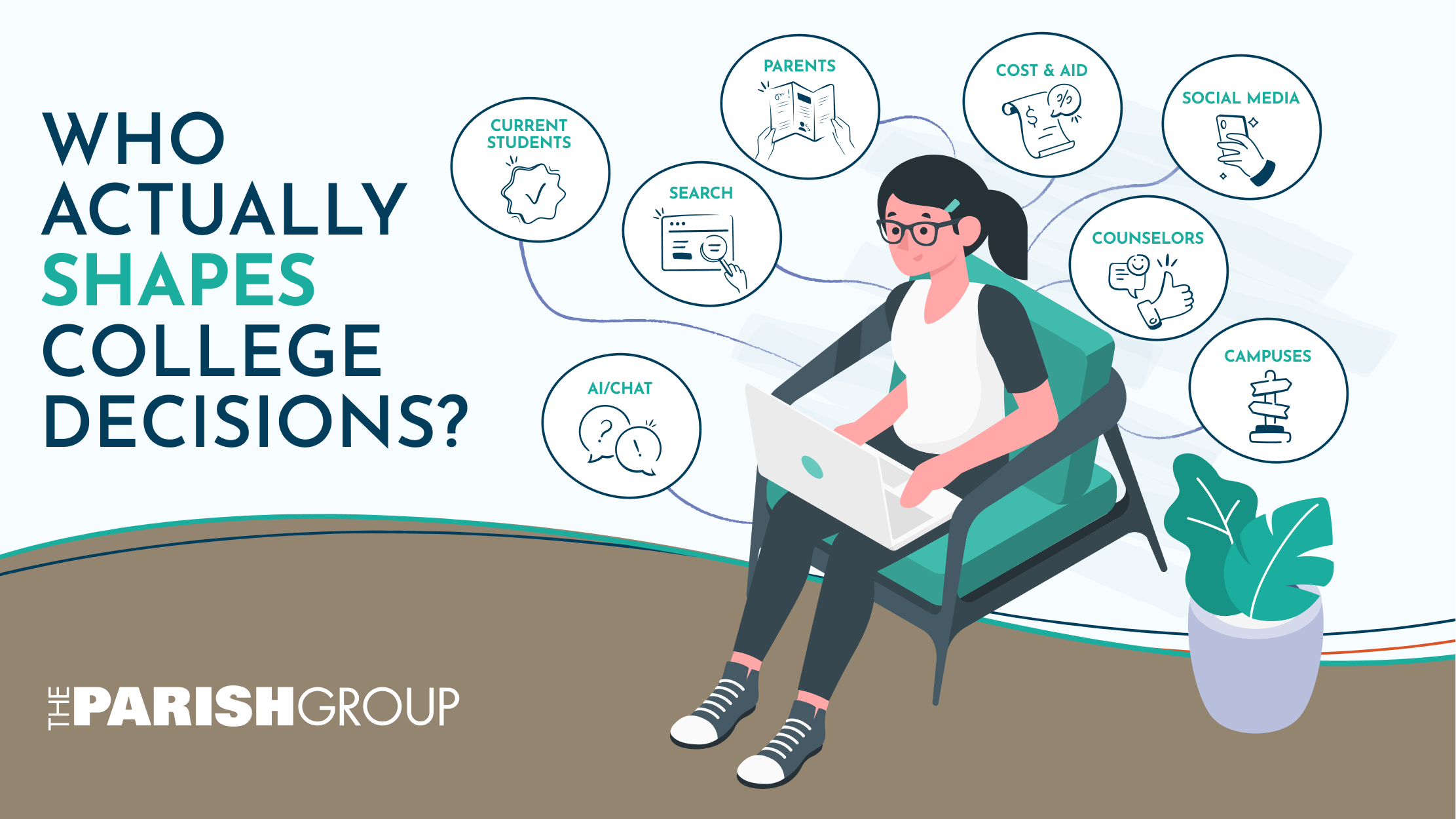
Students may make the final college choice, but they rarely make that decision alone. Parents, counselors, peers, current students, social media, and, increasingly, AI can all influence what students think about colleges and which institutions make their final lists. An entire network of people, platforms, and pressures (ranging from cultural to societal to peer) helps shape that decision.
So who actually shapes college decisions? The better question may be: who doesn’t?
Student Considerations Aren’t Always Exactly Research-Based
Students at four-year institutions consistently reported that choosing their college or university came down to majors or programs offered, overall academic reputation, proximity to home, tuition cost, and financial aid packages or scholarship opportunities (community college students overwhelmingly chose based on geographic proximity to where they live and cost).
Those are all areas where colleges and universities can help shape and control the narratives prospective students get.
But as much as we believe in research, it tends to tell us what factors matter without always capturing the very human things that also go through the minds of teenagers who are often—not always, but often—making one of their first major adult decisions.
Questions like: Can I see myself here? Will I fit in? Will I be successful? Is this worth the cost? What will my life look like if I choose this school? Will I make friends? Is this where my friends are going? Can I be a new version of myself here? Can I stay the old version?
And increasingly, they’re looking for those answers in places institutions don’t completely control. Depending on the survey year, between 62% and 76% of prospective students use social media to research colleges and universities by reviewing their social channels. But 94% of Gen Z are on social media and use at least one platform daily.
While 76% may be going to the social channels of schools they’re interested in, we feel confident that the bulk of students research potential opportunities in other ways. For example, if you want to know if you can be a new version of yourself at an institution, you’re probably not going to an admissions page TikTok, you know? That feels like a job for Reddit or student-created Instagrams (in fact, according to 2025 Reddit-usage research, over half of prospective students who used forums said the content they found confirmed their school choice).
And research from early 2026 finds that 46% of today’s students use AI in their search in some capacity, with 34% of those students saying their interest in an institution has grown because of AI research and 18% taking a college or university off of their list of possibilities because of it. And remember that while AI can help them figure out financial aid packages and areas of study, it will also provide answers to those murkier questions, like “What kind of students really thrive there?”
The implication for today’s colleges and universities is important. Students aren’t waiting for higher education institutions to tell them what to think anymore. And they’re being influenced by platforms institutions have very little control over (for the time being).
Parents and Guardians Still Have a Big Say
A survey conducted by the American Student Assistance found that parents and guardians still have the greatest influence on students’ college and university searches—91% of student respondents reported discussing their post-high-school plans with their parents. Additionally, research shows that students who do not respond to outreach campaigns have a 47% higher likelihood of applying when an institution has their parents’ contact information.
This makes an incredible amount of sense when you factor in that between 64% and 85% of four-year college or university students get some financial support from their families (and while there’s a chance that stat from Sallie Mae could be a bit biased, The U.S. Department of Education found families helped 51% of four-year students pay for tuition and nearly 70% pay for living expenses).
A student may fall in love with a college, but if the cost doesn’t work for the family, that option may never reach the final stage of the decision. Geography, institutional reputation, financial aid, and even perceptions about what type of college is the “right” choice can also be influenced by parents.
The Decision Process Starts Early
There’s another problem with the traditional view of the college search: we tend to think it starts too late.
The typical enrollment funnel suggests a fairly linear progression. A student gets to high school, begins researching colleges, engages with institutions, applies, gets admitted, and eventually enrolls.
Real life isn’t nearly that neat.
Research from Modern Campus found that 49% of ninth graders and 47% of tenth graders surveyed were already “feeling nervous but continuing with the process” when asked about college planning. These students are beginning to think about their futures and explore their options through conversations with parents, peers, and counselors—long before they’re formally reaching out to colleges.
And counselors can play an especially important role here. They may be helping students understand what options exist, what questions to ask, or even which institutions belong on the list in the first place. By the time a college has the opportunity to introduce itself, a counselor may have already helped shape the student’s frame of reference.
And similarly, as we pointed out earlier, reasoning isn’t always clean and objective; with these younger students, the process is often much more emotionally driven than process-driven, which is important to note.
And those early impressions matter. A student who doesn’t understand what makes an institution different—or can’t yet see how college fits into their future—may never make it far enough into the funnel for a carefully crafted recruitment campaign to matter.
The decision is already being shaped before the inquiry form is submitted.
Shockingly, Students Trust Other Students
Research from Niche has found that current students are one of the most influential sources in a prospective student’s college search, ranking ahead of admissions counselors, family members, and friends. And honestly, that makes sense. A current student can answer questions an institution probably can’t—or at least can’t answer in quite the same way; 80% of Gen Z consumers in the U.S. view user-generated content (UGC) as an essential resource for gathering information before making a purchase—and college is a purchase.
What’s it really like to live there? Do people actually hang out on campus? Is it easy to make friends? What happens when you have a problem? Does the experience match what the website promised?
Colleges have been using student ambassadors, takeovers, blogs, videos, and other forms of student-generated content for years. What’s changed—and we previewed this earlier in the first section of our blog—is the scale. Students no longer have to be part of an institution’s official ambassador program to join the conversation. They can post about their experiences, answer questions, share the parts of campus life they love, complain about the parts they don’t, and build an audience of prospective students along the way.
The College Decision Is a Web. Your Strategy Should Be Too
Students may be at the center of the decision, but they aren’t making it in isolation. The college decision is a web—and enrollment strategy needs to account for that.
Start by mapping the decision from the student’s perspective. Who are they talking to? Where are those conversations happening? What questions are each person or platform helping them answer? And where is your institution showing up—or not showing up—with information that can actually help?
A parent may be evaluating cost and value. A counselor may be helping a student figure out which options are worth exploring. A current student may be answering the questions a prospective student is hesitant to ask an institution. A friend may be shaping a student’s perception of a campus before they’ve ever visited it. And AI may be helping them make sense of all of those inputs.
Once you understand that web, you can start looking for the gaps. Are parents getting the information they need to understand cost and value? Do counselors have information they can confidently pass along? Are prospective students finding real student perspectives when they’re trying to understand campus life? Is your institutional content answering the questions students are actually asking—or just the questions you want them to ask?
The goal isn’t to control every part of the web. You can’t. It’s about understanding how the web works—and ensuring you’re providing useful, credible answers wherever decisions are being shaped.