The Parish Pulse is our monthly roundup of higher education trends, enrollment insights, and the industry conversations we’re watching.
Every interaction a prospective student has with an institution contributes to their overall impression. Some of those interactions are carefully planned, while others happen in moments that admissions and enrollment teams may not even be aware of.
From visiting campus to the emails students receive and the people they encounter along the way, prospective students are constantly gathering information about what it might be like to attend an institution.
This month, we’re looking at how colleges and universities can take a more thoughtful approach to those experiences, what they can realistically control, and why the connections between different parts of the enrollment process matter.
We’re also exploring the role of AI in higher education, sharing a new Slate resource, and highlighting some of the conversations we’re following across the industry.
Beyond the Campus Tour: What Really Shapes a Prospective Student’s Visit?
Colleges and universities put considerable time and resources into planning campus visits. But some of the most influential moments in a prospective student’s experience happen outside the official tour.
What are current students wearing? Are people friendly? Does the campus feel welcoming? Can a prospective student picture themselves spending the next four years there?
In our latest Q&A, Beyond the Campus Tour: What Really Shapes a Prospective Student’s Visit?, we spoke with admissions professional and researcher Dr. Justine Whitfield about findings from her dissertation, Beyond the Campus Tour: The Impact of the Campus Visit on College Choice.
Whitfield’s research examined the many factors that shape students’ perceptions of a campus, including aesthetics, personal interactions, and the overall atmosphere or “vibe” of an institution.
Some of those factors are within an admissions team’s control. Others, like weather, construction, or a chance encounter with a current student, are not.
But that doesn’t mean institutions are powerless to influence the experience. Whitfield emphasizes preparing authentic tour guides, paying attention to the broader campus environment, and recognizing that every prospective student arrives with different priorities.
The conversation also explores how campus visits are changing as more students wait until after receiving an admission decision to visit. At that stage, a campus visit may be less about deciding where to apply and more about deciding where to enroll.
For enrollment professionals, the takeaway is that a successful campus visit requires thinking beyond the official itinerary.
For a shorter look at the conversation, we’ve also compiled Five Things Colleges Should Know About Campus Visits.
Getting a Clearer Picture of Enrollment Communications
The prospective student experience doesn’t happen exclusively on campus. Much of it takes place through the communications students receive throughout the enrollment process.
And with multiple departments, teams, and individuals communicating with students, keeping track of those messages can become complicated.
An institution may have strong individual communications, but that doesn’t necessarily mean it has a clear picture of the overall experience those messages create.
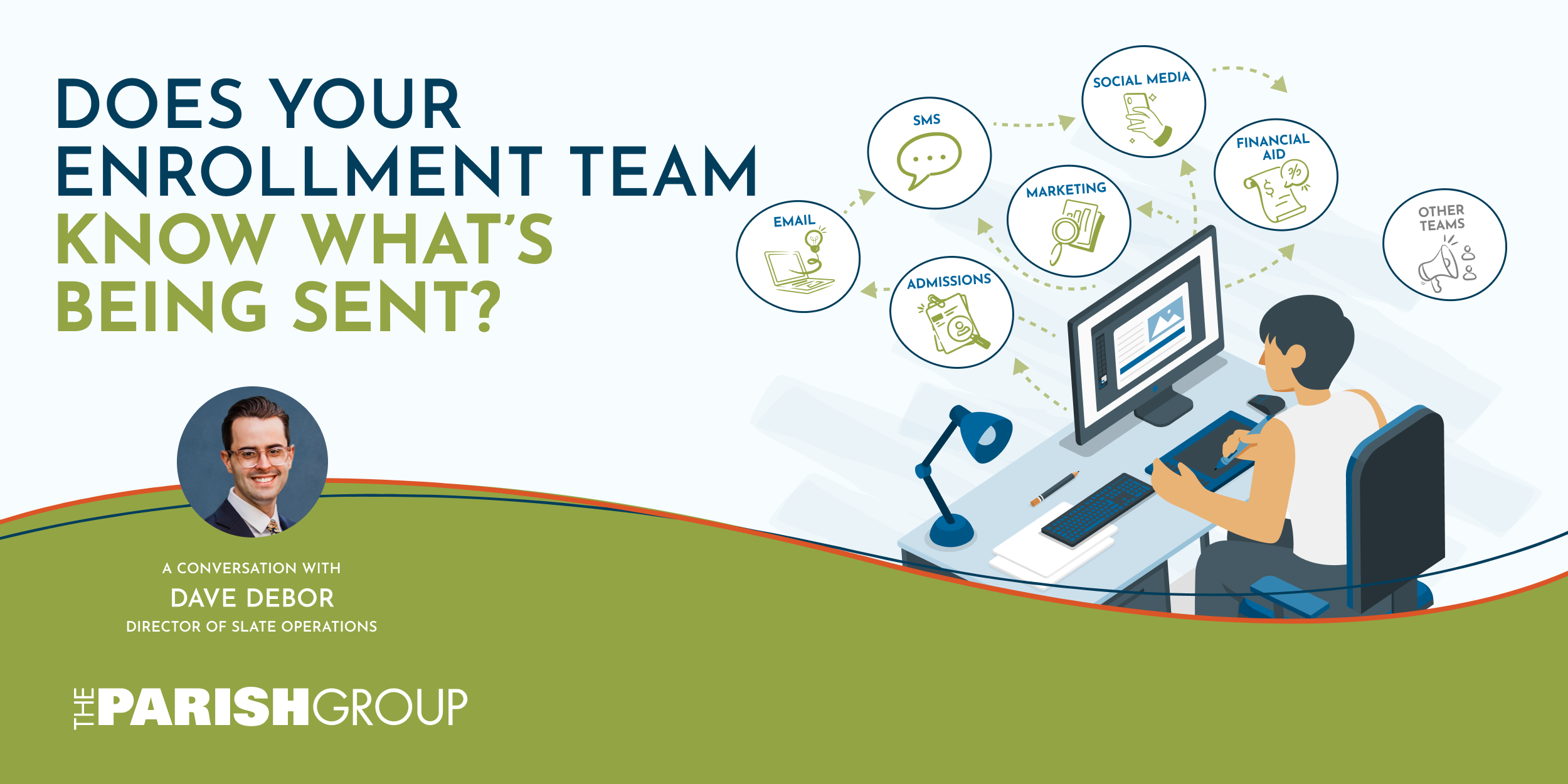
In our November Slate Dive Deeper webinar, Who’s on First? Keeping Tabs on Communications, The Parish Group’s Dave DeBor, Marcus Webb, and Malyn Pickett explore how institutions using Slate can build a user-friendly portal to better manage enrollment communications.
The session covers both the technical aspects of building the portal and its practical functionality, including how teams can track individual messages, see what’s scheduled, and develop a more comprehensive understanding of communications across the institution.
Making the Admissions Experience More Welcoming
As competition for students intensifies, colleges and universities are finding new ways to make the admissions process more welcoming, accessible, and personal.
In his latest piece for The Hechinger Report, education reporter Jon Marcus examines how institutions are rethinking the way they engage prospective students.
The Parish Group’s Dr. Leah Beth Hubbard is among the experts quoted, reinforcing an idea we’ve been exploring ourselves: recruitment shouldn’t be seen as the admissions office’s sole responsibility.
In her earlier piece, Your Whole Campus Should Be a Recruitment Opportunity, Hubbard argued that students and families don’t experience an institution as a collection of separate departments. They experience the institution as a whole.
That means a prospective student’s impression can be shaped by much more than an admissions presentation, marketing campaign, or campus tour.
Should We Really Be Calling AI a Collaborator?
AI has become part of everyday conversations about higher education, from its role in teaching and learning to how institutions use it to manage workloads and develop content.
But as AI tools become more integrated into our work, the language we use to describe them is worth examining.
In an Inside Higher Ed opinion piece, Vanderbilt University’s Catherine McTamaney and Eve Rifkin question the growing tendency to describe AI as a collaborator or colleague.
Their argument raises an important distinction between using technology to support our work and treating it as a substitute for the human relationships that make collaboration meaningful.
For higher education leaders, it’s a particularly relevant conversation. Institutions are exploring ways to use AI to improve efficiency, support decision-making, and free up staff time. But the value of those tools doesn’t necessarily make them equivalent to the people who bring experience, judgment, accountability, and relationships to the work.
As institutions continue experimenting with AI, it’s worth considering not just what these tools can do, but how we talk about their role in our organizations.
A New Perspective on Enrollment Strategy
The conversations shaping higher education don’t begin and end with any one institution, strategy, or enrollment cycle.
The Parish Group’s Senior VP of Enrollment Strategies, Eric Bryan, is launching a new LinkedIn newsletter—Beyond the Funnel—to share his perspectives on higher education, enrollment strategy, and the challenges and opportunities facing colleges and universities.
Drawing on his experience working with institutions, Eric will explore the questions, trends, and ideas influencing enrollment today.
Final Thoughts
Across this month’s conversations, a common thread emerges: the prospective student experience is bigger than any one department, interaction, or communication.
It’s shaped by what students see when they visit campus, the people they encounter, the information they receive, and the way an institution makes them feel throughout the enrollment process.
Some of those moments can be planned and carefully managed. Others can’t.
But institutions can be more intentional about how those experiences connect, whether that means preparing tour guides to have authentic conversations, giving enrollment teams greater visibility into their communications, or making the admissions process more welcoming.
For enrollment marketers, that means looking beyond individual campaigns, messages, and events to consider the overall experience students are having.
You can also receive The Parish Pulse each month as a newsletter. Subscribe here to stay updated on the trends and ideas we’re following.