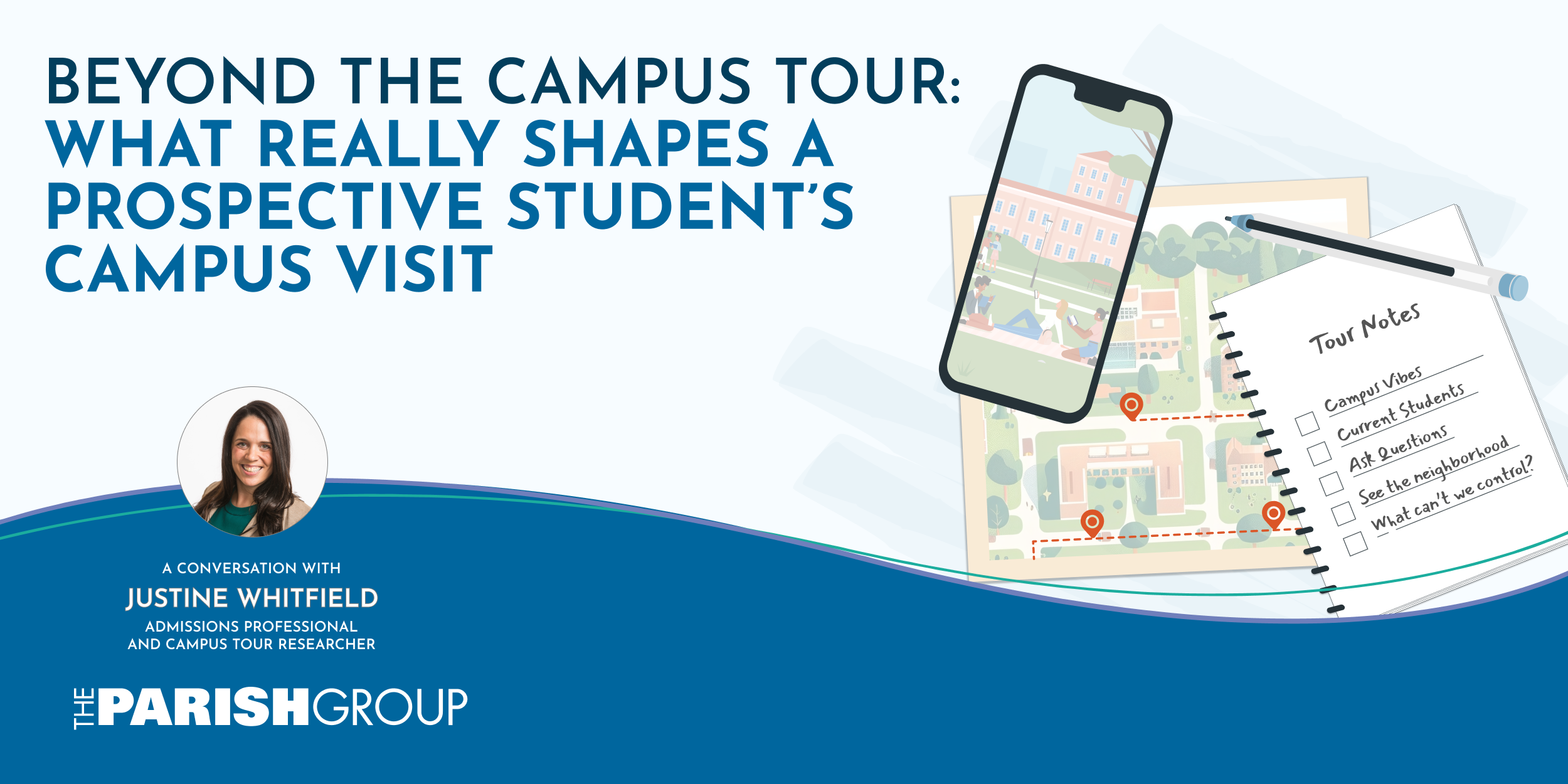
A Q&A With Admissions Professional and Campus Tour Researcher Justine Whitfield
We’ve been thinking a lot lately about what prospective students actually experience when they visit a college campus—and how much of that experience happens outside the carefully planned admissions tour.
In a piece penned by The Parish Group’s Dr. Leah Beth Hubbard, Your Whole Campus Should Be a Recruitment Opportunity, we argued that students and families don’t experience admissions, facilities, academics, student affairs, dining, and operations as separate departments. They experience one institution. Everything from finding a parking space to asking a stranger for directions can shape their impression of what it might feel like to be a student there.
But that raised another question for us: If so much of the campus visit happens outside the moments institutions intentionally plan, what shapes a prospective student’s perception—and how much can colleges and universities really control?
That question led us to Dr. Justine Whitfield, whose dissertation, Beyond the Campus Tour: The Impact of the Campus Visit on College Choice, examined exactly that. Whitfield has also spent years working in admissions and enrollment, giving her both a researcher’s perspective on how students experience campus visits and a practitioner’s understanding of what institutions can realistically do. We talked with her about everything from weather, construction, and what current students are wearing to authentic tour guides, the rise of post-admission visits, and that elusive moment when a prospective student realizes, “I can see myself here.”
While we highly recommend checking out our entire conversation with Dr. Whitfield, a summary version is available here.
A Conversation With Dr. Justine Whitfield About Everything Campus Tours
TPG: Your dissertation looked “beyond the campus tour” at the broader campus visit and how it influences college choice. What first made you suspect that more happens during a campus visit than institutions formally program for prospective students?
JW: While I was in graduate school for my Ph.D., I was also working in undergraduate admissions at The College of William & Mary. There was some pressure for my team of tour guides to ensure that students who visited would apply, and that admitted students who visited would deposit. I knew from my own personal experience that it’s not always that easy.
When I was applying to college, I remember leaving a tour once I found out men and women lived on opposite sides of a lake. I also didn’t apply to a college because they didn’t mention academics at all during the tour. I didn’t even get out of the car after driving by a really urban campus.
I cared a lot about creating a fantastic experience for students visiting William & Mary, but ultimately I knew that more factors were at play than just what we as the institution, campus, and admissions office can control. And my Ph.D. was the perfect opportunity to explore the topic further.
TPG: Your research identified campus aesthetics, the general community or “vibe,” and personal interactions as major factors shaping students’ impressions. Did students notice—or place importance on—anything that surprised you?
JW: What surprised me is that a few students mentioned the clothing of current students. One student, in particular, said that all the women she saw at a specific college were wearing black leggings and Ugg boots. That dates my research, but it definitely stood out to me!
From my own experiences of touring colleges for myself and my sister, I knew aesthetics was a factor that would likely matter in the research, but I was surprised to learn more about the impressions of the general community or “vibe.”
TGP: We’re curious about that idea of “vibe,” because it’s something prospective students talk about all the time but can be difficult to define. What were students actually noticing or responding to when they formed an impression of a campus’s overall vibe?
JW: My research showed that what students wear, how they spend their time, and general attitude about life on campus make up the sense of community or vibe on campus.
It could be the sense of school spirit, the sense of something to rally about. One of the students I interviewed said the biggest deal breaker was a campus where the kids didn’t seem excited about the school. They were not wearing the school’s gear or swag, and students were sitting alone on benches on a gloomy morning (see—weather makes a difference!).
Students paid close attention to whether others were talking to one another on their way to campus as another vibe check. They examined bulletin boards like hieroglyphics, taking in students’ conversations at coffee shops and local restaurants to get a sense of the campus vibe.
TPG: One of the most fascinating findings for me was how much a student’s impression can be shaped by things admissions teams don’t necessarily control: weather, construction, bulletin boards, the particular tour guide they happen to get. If so much of the campus visit is subject to chance, what can institutions meaningfully control?
JW: This is a great question! I think it is essential for schools to do a couple of things. First is to focus on tour guides. One essential thing is preparing tour guides for tough questions. Tour guides will be asked whether the weather is always bad if it’s raining; they will be asked how noisy construction is, etc., and about anything currently in the news. Prepping tour guides to answer some tough questions in their own words is key.
Next, you can control what tour guides wear to an extent. At the end of the day, tour guides should be wearing the college logo. Sometimes polos can come across as too corporate or fake, so it’s a delicate balance depending on the institution. But ensuring tour guides wear the college name does make a difference.
Next, colleges/universities have to be prepared for weather—it is essential to have a backup plan and be able to pivot. It’s better to give your guests a markedly different experience than have them trudge through rain or snow and leave your campus miserable.
I also really appreciate being able to choose which tour guide I want to follow for a campus tour. Occasionally, going on a tour with someone of a shared hometown/state, major, or extracurricular interest can make all the difference in an impression of a campus and community.
Admissions offices also have to pay attention to the campus surroundings. That may mean scanning college newspaper headlines, walking the campus tour routes in advance, and sometimes even picking up trash. It’s not easy to build a campus community where everyone cares about shared spaces, being friendly to strangers, and wearing the brand itself—that’s why admissions offices must attend to the areas they can control for prospective students.
TPG: We recently published a piece called Your Whole Campus Should Be a Recruitment Opportunity, arguing that everything a prospective student encounters can influence their perception of the institution. Based on your research and your subsequent career in enrollment, how true does that feel?
JW: Everything matters! Emails, perceptions from family, friends, peers, sports team performance, news, and current events all matter to students when they make decisions.
Even when students make their final decision and then ultimately get offered a spot off the waitlist at a school they may have otherwise listed first, they are often more emotionally invested in the other school at that point. They may have attended admitted students day, found a roommate, bought the college swag, and posted online about the original school that accepted them.
Even if a student doesn’t list a school as their first choice, a scholarship or honors program can still change the game, as I have seen in my enrollment work. I have worked with many college students who chose a college because of the scholarship or financial aid package, sometimes sight unseen. The factors that matter most vary from student to student, and a college applicant’s priorities can often change on a whim.
TPG: You’ve talked about students using the campus visit to determine whether they can picture themselves living and thriving somewhere—not simply whether a school checks their academic boxes. What creates that elusive feeling of “I can see myself here”?
JW: In my dissertation, I called this the “say yes to the dress moment.” It’s important to find a college where a student can live and thrive. College comes with tough days, and ideally students can cope with the pressures of that environment. Which means proximity to small things like Target, the beach/mountains, and urban/suburban neighborhoods really do matter.
I think it is important for students to do a good amount of self-reflection and think about what makes them happy. How far away do they want to be from home? Do they like driving? Where do students tend to live and move after graduation? All of these factors affect overall happiness.
I think you can best feel “I see myself here” when you love a college on a bad day in the pouring rain, in the heat of summer, or the cold of winter. When the weather is bad and you still like the surroundings, it’s likely a fit!
TPG: There seems to be some push and pull between intentionally creating a great visitor experience and creating something so polished that it no longer feels like an authentic day on campus. How should institutions think about that balance?
JW: I feel strongly that tours shouldn’t be scripted and memorized; they should be authentic.
When I was at William & Mary, I couldn’t pay the tour guides, so I taught an academic class to give them better training and enhance the overall tour.
We did reflection papers on why William & Mary—favorite tradition, favorite class, etc. Then it was easier to build a high-quality tour experience. We wanted students to talk about academics and the overall curriculum, but also share stories about their favorite class and favorite professor, etc.
I distinctly remember being on a scripted tour for my dissertation research when a student proudly stated, “With great power comes great responsibility,” and then a few minutes later we walked by another tour guide saying the exact same thing.
Prospective students and families can sniff out inauthentic moments. Not everything about a college will be perfect. There will be construction, expensive or hard-to-find parking, registration challenges, etc. A tour guide that is not open or honest enough will be difficult to trust for prospective students.
TPG: We’re also seeing more students apply first and visit later, rather than using the campus visit primarily to decide where to apply. Does that change the purpose of the visit? And should institutions approach a visit differently when a student is already admitted—or potentially deciding whether to deposit—than when they’re still building their college list?
JW: Absolutely! This is a trend I am seeing more and more now. Many more students are waiting until they are admitted, and honestly it is super smart. When I was applying to college, the Common Application was just starting, so students were not applying to as many colleges as they are today. With the ease of submission, it is even harder to assess your likelihood of admission today, even when your GPA and/or test scores seem to be in the right range.
Now I have a stepdaughter in high school, and we are beginning the process. I think it is important for families to tour at least one or two nearby schools just to give the student the opportunity to discover what is important to them in a college to build their list for applications, and then work with their college counselor to ensure their list has some reach schools, some matches, and some likely acceptances. A good mix of schools will yield different results in any given year.
By visiting after acceptance, the student has already assembled in their mind a lot of information about how the school communicates, the brand identity, and the personal feelings and emotions that come along with that specific institution. At this stage, a personalized and significant visit experience is essential, as they are visiting while also asking themselves, “Could I see myself here in a few months?” Items that are slight turn-offs during a campus visit in sophomore or junior year matter far more when a student visits at the end of senior year.
TPG: Since completing this research, you’ve spent years working in admissions and enrollment yourself. Is there anything you believed about campus visits when you finished your dissertation that your subsequent experience has complicated, changed, or reinforced?
JW: In terms of complicated, I would say the rise of social media has complicated the college admissions and commitment process. Now there are many more “college experts” on TikTok, Instagram, etc., spouting advice. You also have many more students sharing their experience as college students and as applicants. All of this can be good or bad depending on the information, but it certainly changes the game as schools have no control over what is being said.
As for change, I agree that the biggest change is that more families are waiting to do broad, sweeping college tours until after college decisions are made and sometimes scholarship/financial aid packages are released. There is more pressure than ever to choose a degree with a higher ROI, and federal student loans are more complicated to obtain. Parents and students are more concerned than ever before about outcomes.
In terms of reinforcement, I would say campus visits remain very important in decision-making.
This interview has been edited for length and clarity.
Each month, The Parish Group talks with researchers, experts, and practitioners whose work can help us think differently about higher education, enrollment, and marketing. Catch up on our recent conversations with Syracuse University Professor Carrie Riby on AI-generated advertising, researcher Sophie Renton on marketing to Generation Alpha, and writer and LinkedIn influencer Charlsie Niemiec on creating unique content.