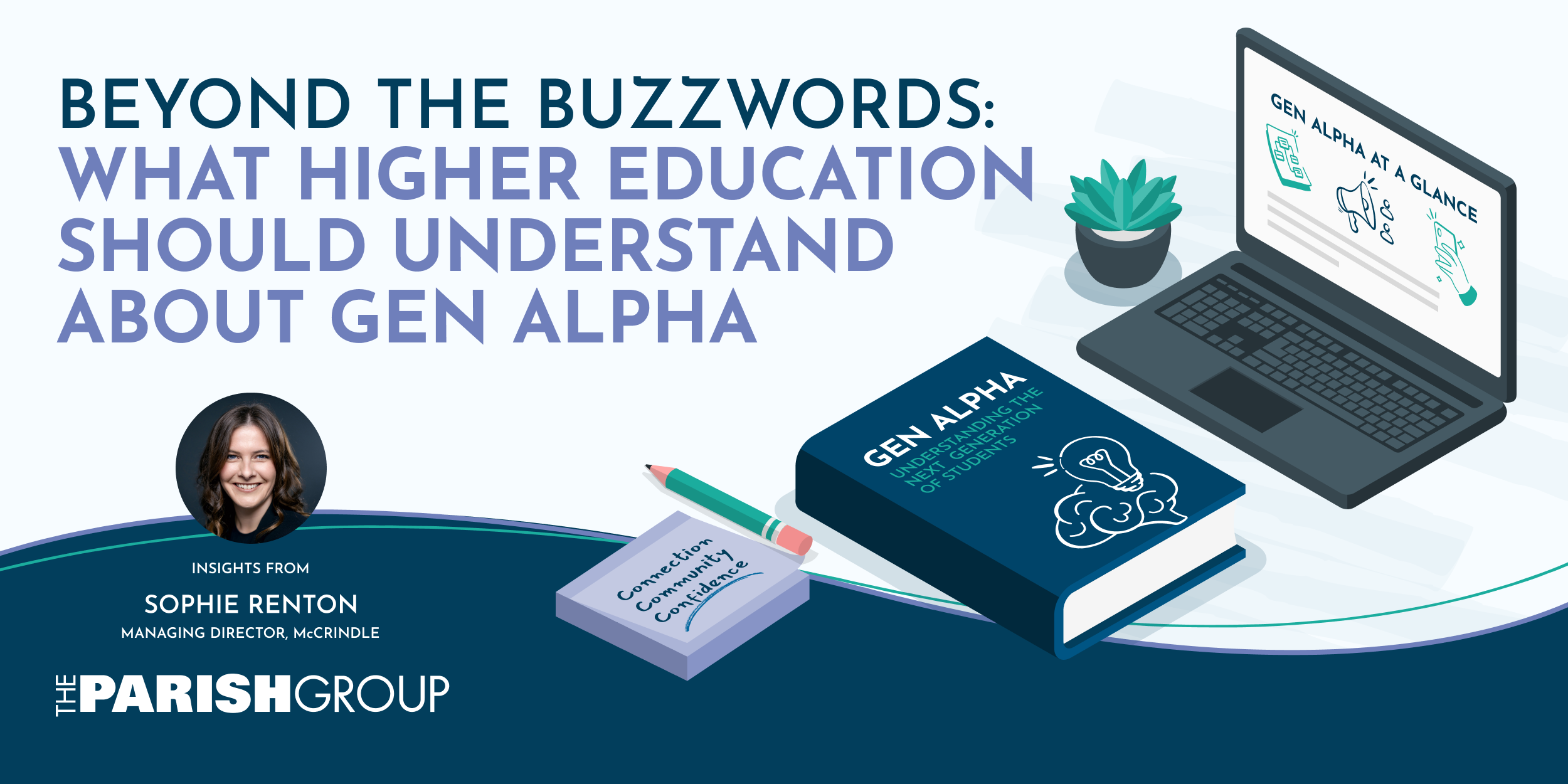
McCrindle’s Managing Director, Sophie Renton, on AI, human connection, and preparing for the next generation of students
Every generation gets a story written about them before they have a chance to write it themselves.
Gen Z has been described through a steady stream of headlines: digital natives, the anxious generation, the generation reshaping work and identity. Now, as Generation Alpha (Gen Alpha) enters the conversation, we’re seeing many of the same patterns emerge. They’re the iPad generation. The AI generation. The generation with different expectations for school, work, and the future.
Some of these observations may reveal meaningful shifts. Others are generalizations that get repeated so often they start to feel like fact, and become part of Generation Alpha’s narrative.
So how do organizations—particularly higher education institutions—know the difference? When does adapting to a new generation reflect a real cultural shift, and when are we simply chasing the latest trend?
The students who will enter college in the coming years are being shaped by major forces: rapid advances in technology, changing definitions of success, and a world where access to information looks fundamentally different than it did for previous generations. But understanding those forces requires more than a list of generational traits. It requires research, context, and a willingness to look beyond the assumptions.
That’s why The Parish Group reached out to McCrindle, the Australian research firm that coined the term Generation Alpha nearly two decades ago. We were lucky enough to chat with Sophie Renton, Managing Director at McCrindle, who was so generous with her time and insights, to explore what research actually tells us about Gen Alpha—what we know, what we’re still learning, and what higher education leaders should be thinking about now.
If your institution is preparing to recruit, support, and engage the next generation of college students, this conversation offers an expert-backed perspective on moving beyond generational stereotypes and understanding the deeper shifts shaping the future of higher education.
While we highly recommend checking out our entire conversation with Sophie, an abridged version—a TLDR, as Gen Alpha might say—is available here.
A Conversation With McCrindle’s Sophie Renton on Understanding Gen Alpha
TPG: McCrindle coined the term “Generation Alpha” nearly two decades ago. Looking back, what’s one thing people misunderstood about the purpose of naming a generation in the first place?
SR: I think this is a great question to start off with, because it can debunk some of the myths around generations being stereotypes and causing more division. And yes, those are things that we need to be aware of: that they can be generalizations and stereotypes. But they can be useful as well, because if we’re trying to talk about the whole population at once without any names, it becomes very difficult to compare and contrast different life stages and generations.
The purpose of naming the generations is to track social shifts over time, because each generation has a life-stage-appropriate element. So, the Baby Boomers, you know, when they were in their family-forming years, might be showing some characteristics similar to those of Gen Ys in their family-forming years.
But there is also what has shaped you in your formative years, and that’s where we see the generational analysis being really powerful to help us ask: what are those unchanging markers that shape a generation as they go through life? A scientific naming system allows us to compare and contrast and track those social shifts over time.
And we really chose the Generation Alpha name, particularly from a survey, because some people said, well, you know, if we’ve got to the end of the alphabet, let’s just go back to the beginning. For us, it wasn’t a return to the old, but the start of a whole new generation, a whole new time.
TPG: How much of what we currently believe about Gen Alpha is based on evidence, and how much is still educated speculation?
SR: I would say there’s still a level of educated speculation. I really liked that phrase about Gen Alpha because it’s not just made up out of nowhere. It’s looking at behavior, it’s looking at traits, it’s looking at what we can see so far, and extrapolating that out, and going, if this continues, these might be some patterns.
But there is also some that is evidence. We’ve done some surveys through kid social media apps where we could actually survey Gen Alpha, and that is hard data. We have conducted focus groups with parents and their Gen Alpha children, and spoken with Gen Alphas themselves. So there is definitely some data shaping this generation, but I think over the next 5-year period, it’s going to be really interesting when Gen Alpha, through standard research methods, can contribute their voices to the conversation.
TPG: As more research emerges, what’s becoming more nuanced about our understanding of Gen Alpha?
SR: I loved this question, because I think it’s always so important to go back and re-look at things that you’ve believed or you’ve said, and I think if we look at Gen Alpha, they were born in the year that the iPad was released and Instagram was launched. So, digital technology and social media have been integrated into their life from the very beginning.
So, from the get-go, a lot of the commentary around this generation has been that they are going to be digitally literate; it’s going to be integrated into everything that they do, and I think that is still true. They’ve only known a world with this level of technology integration and social media, so to completely strip that out is probably unlikely.
But also, as we’ve pushed so far into this tech space, we’re seeing the pendulum swing back to say, “Hey, we actually want real relationships.” For example, more than half of Gen Z (57%) have said they wish social media was never created—and it will be interesting to see what Gen Alpha says too. So, this pushback and this reclaiming of analog, friction, and personal connection in their world, I think, is something we’ll see more of in the future with Gen Alpha.
TPG: What’s the biggest misconception society has about Gen Alpha today?
SR: Some of the attitudes or behaviors—that are entitled, they’re soft, they lack resilience, they don’t work hard, and all of this kind of commentary—isn’t accurate. If you look back, it’s attributed to every young generation. I would say there’s a level of youth to that, where you haven’t developed your empathy yet, and there is an element of self-focus to you.
But I think this generation coming through is kind, conscientious, and caring; they are exceptionally tolerant of diversity, much more than some other generations. They care deeply about the environment and are trying to actually leave this world better. They just don’t necessarily have a huge number of tools in their toolkit to act on those views and beliefs yet—I don’t like seeing them get written off as an entitled generation that isn’t going to amount to much before they’ve actually had an opportunity to make their mark.
TPG: Gen Alpha is often described as “AI natives.” Do you worry we’re overestimating AI’s influence simply because it’s the newest variable? Twenty years from now, do you think that’ll still matter?
SR: I think it will matter, if you look at history, as that’s sometimes a great lens to look forward. Gen Z really came of age on social media, and it was the first generation to really experiment with their youth there. We’re seeing Gen Z now push back, so I wonder whether we’ll see a similar thing with AI.
The other thing I think is significant about AI is that other technologies were additive; they added to our lives. Whereas I see AI as a little bit more transformative than other technologies. You often hear AI compared to a calculator, where we were told that we were never going to carry a calculator around in our pocket. But when you have a calculator, the human is still the one thinking, “This is the calculation I need to make; I need to put these numbers in, and now I need to decide: have I actually done that calculation correctly?” So the cognitive load still rests with the individual. The human remained in the driver’s seat.
However, with AI, what I see as a bit of a concern is the outsourcing of the cognitive load and the critical thinking. Now, there are some tasks that that’s fine, and it’s just a win to outsource the cognitive load. But I would have concerns if this generation yields their agency in their formative years without good safeguards in place. So I think the jury’s out on how it’s going to play out.
TPG: What’s something that higher education institutions can do to help Gen Alpha not yield their agency and outsource their thinking to AI?
SR: In the formative years of older generations, we have learned how to think critically. We’ve learned how to follow a logical progression, so we can bring that thinking to the AI world.
If Gen Alpha never gets the chance to really develop and hone the skill of navigating complex problems, then they will forever be dependent on AI. For older generations, AI is just amplifying the skills we already have; it’s not replacing them. So, I think if we can teach Gen Alpha to embrace AI as a tool while rejecting cognitive surrender, that’s when we position them well.
And so, for the role that higher education could play, it’s thinking about how we teach that logical, critical thinking, where you actually have to sit with a problem that’s sticky, and messy, and there’s not a simple solution—you can’t just write three sentences into whatever your LLM is that you use, and it pops you out an answer, because actually the formation happens in the middle. I think we need to not shy away from that middle, sticky place, but be willing to sit with it and walk through it, because that’s where learning happens that sets us up for the future.
TPG: What’s one assumption that’s working today with Gen Z that you don’t think will hold true for Gen Alpha?
SR: With Gen Alpha, we need to recognize that the structural progression post-school of going to higher education isn’t necessarily seen as a pathway that is going to help them succeed in life.
So, when you or I finished school, it was just: you go to university, you get a degree; the social contract was that if you did that, you would be employable, you would buy a house, you would get XYZ.
So much of the social contract surrounding the pursuit of higher education is being dismantled at this time. So if people don’t see it as the pathway to future success anymore, I think that changes how we need to approach marketing to this generation. So some will still choose it; it’s just not as much of a given.
And when we look at Gen Z and those coming into higher education at the moment, and consider what their ideal jobs are, most want to be involved in some level of entrepreneurial activity, and the barriers to entry for that with AI are even lower. So, the desire is to not just go work for the man, but to have their own freedom and their own life.
So the end goal is different, and the pathway may look different, and I think that is a real opportunity for higher education to go, “Okay, we didn’t kind of have to think about it for a while: university was part of the plan to succeed in life.” If university isn’t necessarily a given in the plan anymore, how do we tap into what matters to this generation?
That’s where I come back to things like critical thinking and adaptability: they can come and learn those skills they can then apply in their own world, in their own space, rather than, “Here’s your 10-step course to be employable with this employer at the end.”
TPG: If you walked into a higher education marketing department tomorrow, what’s the first conversation you’d want to have with the team?
SR: I would want to understand why people are already choosing the university that they are the marketing team for. So, what is their differentiator at the moment, and how do you either leverage that, or if you don’t know, how do you find out what it is?
I would also want to understand what they have noticed about their students over the last decade, what has changed, what they have observed, and what the drivers have been. But I think what I would also love to see is the future they envision for their students—knowing what the institution envisions for its young people is an important part of that equation.
TPG: What’s one investment you’d encourage higher education institutions to start making today that may not pay off for another five or ten years?
SR: It’s important to note how your offers connect with purpose.
In our book on Generation Alpha, we wrote that this is the options generation, but we do them no favors if we set them up with endless options but no sense of purpose. And if we look at the key drivers of young people’s careers today, it’s that they want to make a meaningful difference.
If institutions can think, how can I partner with these young people to help them actually achieve what they already want in their lives? That, I think, is a really different way of looking at the higher-ed experience. It’s not, come in, learn who we are, and go out as a graduate of us, but think, actually, who are you? What do you want to achieve? And what are the skill sets, the courses, and the environments that we can create that can partner with you to help achieve what you already want to do?
TPG: When does adapting to a new generation become chasing trends? How should organizations distinguish between a true generational shift and a short-term cultural moment?
SR: I think this comes down to the core of how do you not just chase a fad, but have a strategy that will last? And I think using human-centered foresight is a really key part of this equation.
We often talk about having a strategy that doesn’t just focus on what is changing, but also what is unchanging, and really, those are timeless human needs. We did this matrix image in our megatrends report on shaping consumer behavior, and we looked at a number of consumer paradoxes, but what we really compared there was the timeless human needs and brand opportunities. If we look at those timeless human needs of belonging and identity, they rarely change. No matter what fad comes, that core need remains constant.
For example, the human need for trust and safety never changes. You might use different tools to appeal to it, but the core need remains the same.
In terms of higher education, ask what core needs need to be met or need to be acquired, and then what tools or skills are the best expression of that? And I think if you focus on the timeless human needs and the timeless purpose of higher education, that helps you develop a strategy that remains stable, and then you innovate on the tools that implement that strategy.
TPG: If every higher education leader remembered just one thing from this conversation, what would you want it to be?
SR: Stay curious, because this is what we know about this generation at the moment. It will keep changing and evolving because that is humanity. People never stay the same.
So stay curious, keep learning, be intentional about that. And then I would say remember what brought you into higher education to begin with, and let that drive you.
This interview has been edited for length and clarity.
Ready to turn these insights into action? Explore practical strategies for connecting with the next generation of students in our guide to marketing to Gen Alpha.