McCrindle—a prominent Australian research firm—has spent nearly two decades studying generational change, and, in fact, its founder, Mark McCrindle, is the researcher who coined the term “Generation Alpha” (and, quite literally, wrote the book on it) and introduced it into our lexicon.
Here at The Parish Group, we’ve been thinking—and writing about—Gen Alpha a lot lately, as the next generation of students attending colleges and universities. In particular, we’ve been thinking a lot about what Gen Alpha insights are actually worth noting, and what’s just headline-grabbing discourse.
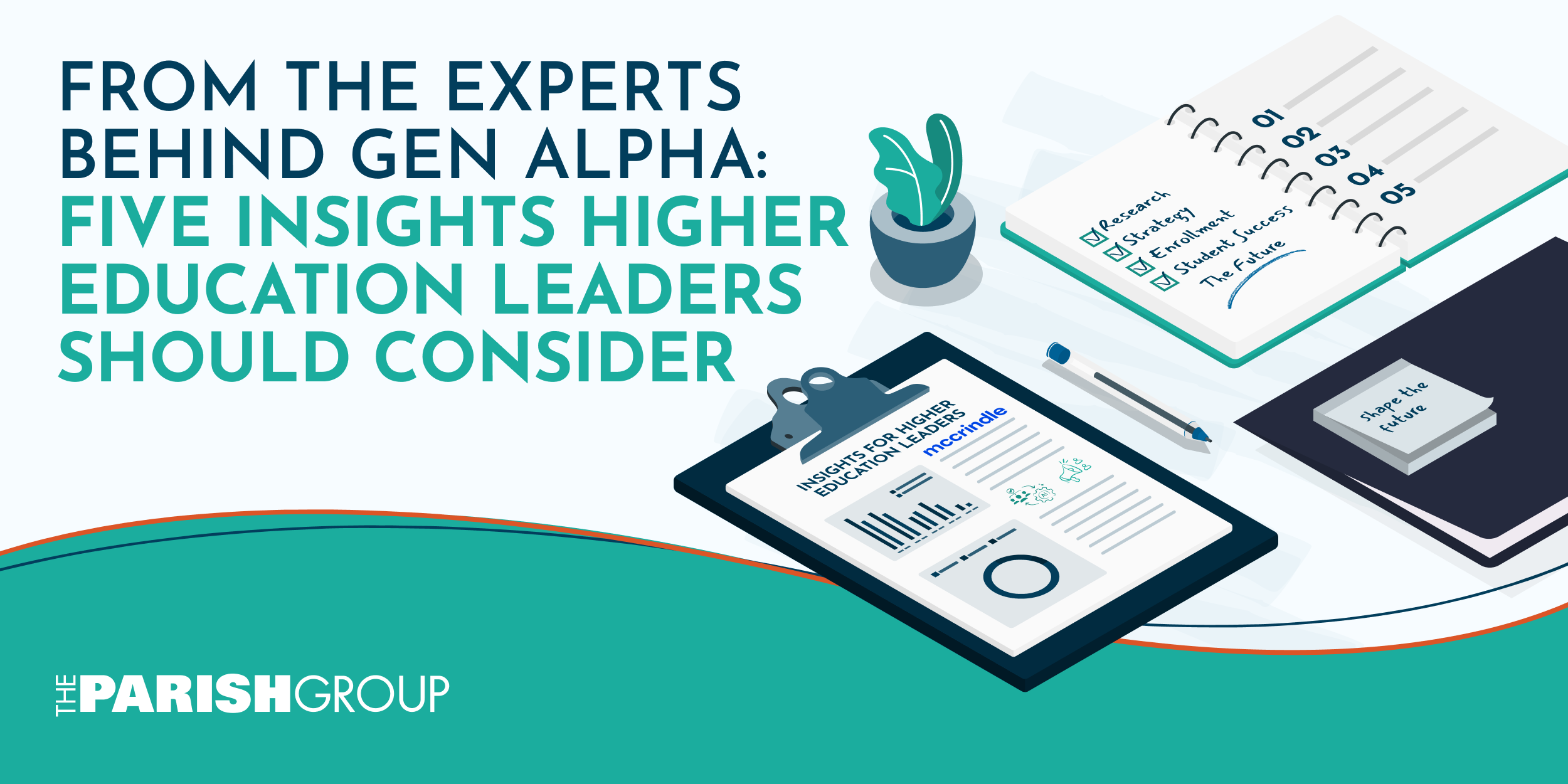
That’s why we went straight to the source and spoke with McCrindle Managing Director Sophie Renton to explore what their research reveals about the next generation of students. The conversation is wide-ranging, covering everything from AI and critical thinking to human connection, purpose, and the future of higher education.
While the full interview offers valuable context and a deep dive, a handful of ideas continued to stand out long after the conversation ended.
If you’re looking for the highlights, here are five Gen Alpha-driven insights higher education leaders should consider as they prepare for the students of tomorrow.
Five Gen Alpha-Driven Insights Higher Education Leaders Should Consider
Generational Labels Are a Starting Point—Not the Conclusion
Renton began our conversation by addressing one of the biggest misconceptions about generational research: naming a generation isn’t about assigning a personality. It’s about creating a shared framework for understanding how historical, cultural, and technological forces shape people over time.
“If we’re trying to talk about the whole population at once without any names, it becomes very difficult to compare and contrast different life stages and generations,” she told us. The purpose of naming generations is to track social shifts over time, not make sweeping generalizations that stick with them as they grow and evolve.
For higher education, that’s an important reminder. The goal isn’t to market to stereotypes—it’s to understand the forces shaping future students.
Digital Natives Still Crave Human Connection
It’s easy to assume that because Gen Alpha has grown up surrounded by technology, they’ll naturally prefer digital-first experiences. Renton believes the research paints a more nuanced picture.
“As we’ve pushed so far into this tech space, we’re seeing that pendulum swing back to say, ‘Hey, we actually want real relationships,’” she says.
She also pointed to a growing desire for “analog and friction and personal connection.”
For colleges and universities, that reinforces something many institutions already do well: creating places where students build friendships, find mentors, and experience community. Technology will continue to evolve, but the value of meaningful human connection isn’t going away.
AI Should Amplify Students’ Thinking, Not Replace It
Few parts of our conversation felt more timely than Renton’s perspective on AI.
Unlike previous technologies, she argued, AI has the potential to outsource cognitive work rather than simply support it, and notes that concerns about it are very real.
“What I see as a bit of a concern is the outsourcing of the cognitive load and the critical thinking,” she told us. “Now, there are some tasks that that’s fine, and it’s just a win to outsource the cognitive load, but I would have concerns if this generation yields their agency in their formative years without good safeguards in place.”
She made a good point, so we followed up and asked what higher education institutions could do to help Gen Alpha avoid ceding their agency and outsourcing their thinking to AI.
Her advice for educators was simple—and memorable. “I think if we can teach Gen Alpha to embrace AI as a tool while rejecting cognitive surrender, that’s when we position them well.”
That messy process of wrestling with difficult questions, solving ambiguous problems, and thinking critically may become one of the greatest differentiators of higher education in an AI-powered world.
Higher Education’s Value Proposition—And Thus, Messaging—Is Changing
For previous generations, attending college often felt like part of an unwritten social contract. Today, that assumption is less certain.
“University isn’t necessarily a given part of the plan anymore,” Renton says. Rather than assuming students already believe in the value of higher education, she challenged institutions to reconnect their offerings with students’ aspirations.
“Who are you? What do you want to achieve? And what are the skill sets, the courses, and the environments that we can create that can partner with you to help achieve what you already want to do?”
That’s a subtle but significant shift—from asking students to fit into an institution’s story to helping them write their own.
Build Strategies Around Timeless Needs, Not Trends
Perhaps the biggest takeaway from our conversation wasn’t about Gen Alpha at all.
It was about how institutions should approach change.
Renton encouraged organizations to focus not only on what’s changing, but also on what’s constant.
“Have a strategy that doesn’t just focus on what is changing, but also what is unchanging,” is key, she says.
She pointed to needs like belonging, identity, trust, and purpose—needs that transcend generations, even as the tools and technologies around them evolve.
As higher education prepares for Gen Alpha, that may be the most valuable lesson of all. The platforms will change. The headlines will change. Even the way students learn and communicate will continue to evolve.
But the human needs that draw students to higher education—and the role institutions play in helping them become who they hope to be—remain remarkably consistent.
For more insights from Sophie Renton, including her thoughts on AI, entrepreneurship, and what higher education leaders should be thinking about now, read our full interview.