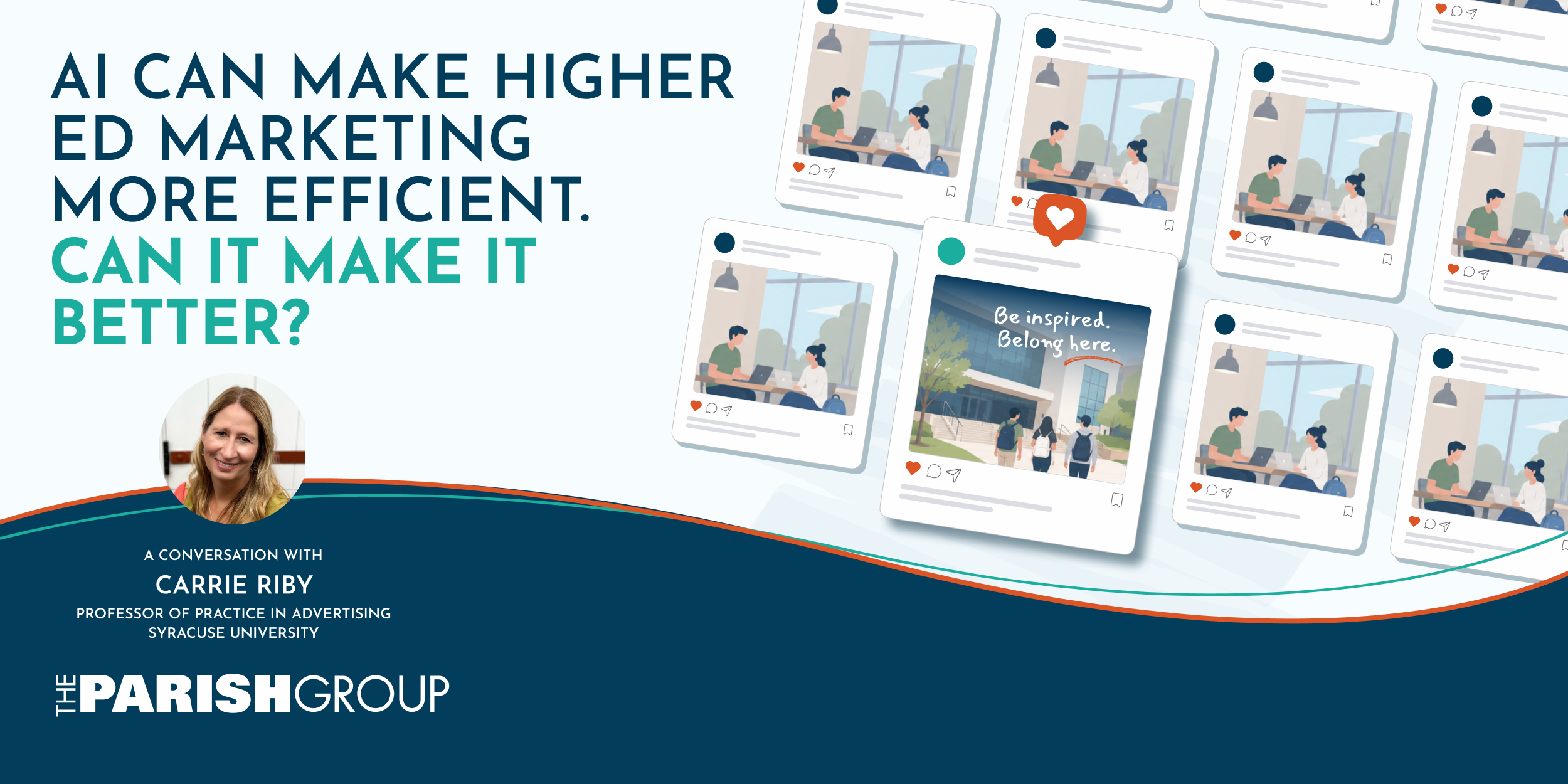
AI-generated advertising has gotten remarkably good at looking like the real thing. A recent study from Ipsos and Syracuse University’s S.I. Newhouse School of Public Communications found that consumers largely couldn’t distinguish between AI- and human-created ads. But there was a catch: the human-created work still performed better.
The research team—comprised of Adam Peruta, Director of Advanced Media Management who researches how generative AI will impact the future of media, and Carrie Riby, advertising professor and Director of the Advertising Graduate Program (who also has an impressive, decades-long career in advertising and wrote “The Art of Advertising Strategy”), Ipsos Executive VP Ryan Barthelmes, and Ipsos Creative Research Director Nate Cummings—compared human-created ads with fully AI-generated versions built from the same strategic briefs.
For higher education marketers, the findings raise an important question. As AI makes it possible to create more content more quickly and efficiently, how do institutions ensure they’re using these tools strategically rather than simply to produce more? The opportunity isn’t necessarily to choose between human creativity and AI, but to understand where AI can add value, where human judgment still matters, and how the two can work together to create communication that actually connects with prospective students.
How colleges and universities (as well as those who help colleges and universities, aka, ourselves) can strategically, meaningfully, and ethically use AI, is something we’ve been thinking and writing about a lot lately (we linked to the Ipsos/Syracuse University Study in our blog AI Is Raising the Stakes for Campus Photograph), but since Riby and Peruta are the experts here, we reached out to them, and had really insightful chat with Riby about what AI is changing for marketers, the difference between efficiency and effectiveness, and what higher education communicators should consider as they build AI into their own strategies.
While we highly recommend checking out our entire conversation with Professor Carrie Riby, a summary version is available here.
A Conversation With Syracuse University Professor Carrie Riby About Her Study, “AI Ads Are Good Enough — And That’s the Problem,” and the Future of AI in Marketing and Advertising
TPG: Based on your research, where is AI proving effective for marketers, and where does it still fall short?
CR: Most marketers are using AI in some form to create advertising, but the emotional side often doesn’t come through. AI is excellent for efficiency, but it still struggles to create real consumer connections. That’s one of the main reasons we worked with Ipsos on this project: they evaluate advertising based on emotion, including the creative experience, empathy, and the strength of the creative idea. Based on Ipsos’ experience with more than 40,000 ads, we know when an ad delivers on those three emotional components, ad sales increase by 20%.
Using that framework to compare AI-generated ads with human-created ones, we knew that if an AI ad included all three elements, it could have a meaningful impact on our audience.
And what we found was that the AI did well communicating product-oriented ads. Ads that comprise a simple problem and solution framework. Think about your standard shampoo ad communication. You want clean, beautiful hair that is soft and shiny. For ads like these, AI is going to produce a perfectly good ad. It’s going to mimic all the other shampoo ads that have ever been created and reside on the internet, and it’s going to create an acceptable ad that shampoo consumers will find appealing.
But if you’re asking AI to do something with puppies and kittens that are emotional or even humorous, AI is not going to cut it, and that’s a problem. Nowadays, humans are seeing so much of this—excuse the term—AI slop, it’s hard to stand out. Emotion is needed to take the ad messaging to the next level.
TPG: What do most marketers get wrong when they begin having conversations around “AI”? Do you think generally, most marketers understand the limitations of AI or are they just excited to use it and increase output?
CR: I’ve been around since the beginning of the dot-com era. The unknown can be intimidating, and the future hard to predict. But look where we are 30 years later, can you imagine a world without the internet?
It’s no secret that most marketers now use AI. It has changed how we create, communicate, and operate, allowing us to work faster and more cost-effectively. But should we leave it all to the machines?
Remember this new, shiny technology is also changing consumers’ behavior and trust is at the center of this connection. The question is, can you build trust, with something people are hesitant to trust?
Bring this back to our research; what was most enlightening for me in this whole process was how good AI ads were. The difference was only a 14 percent index with human-created ads outperforming their AI counterparts. In the scheme of things, that’s not a huge margin.
Where we saw AI fail horribly, and that comes back to what I call the puppies and kittens scenario, AI just couldn’t come close to the impact that the human-oriented ads could produce.
The AI/Human hybrid approach might be one solution providing the balance between
the efficiencies that CEOs desire, and the human connection marketers crave.
TPG: So, do you think it’s safe to say that, like, AI can create compelling content, but that humans still need to be the ones creating the effective communication narratives and storytelling?
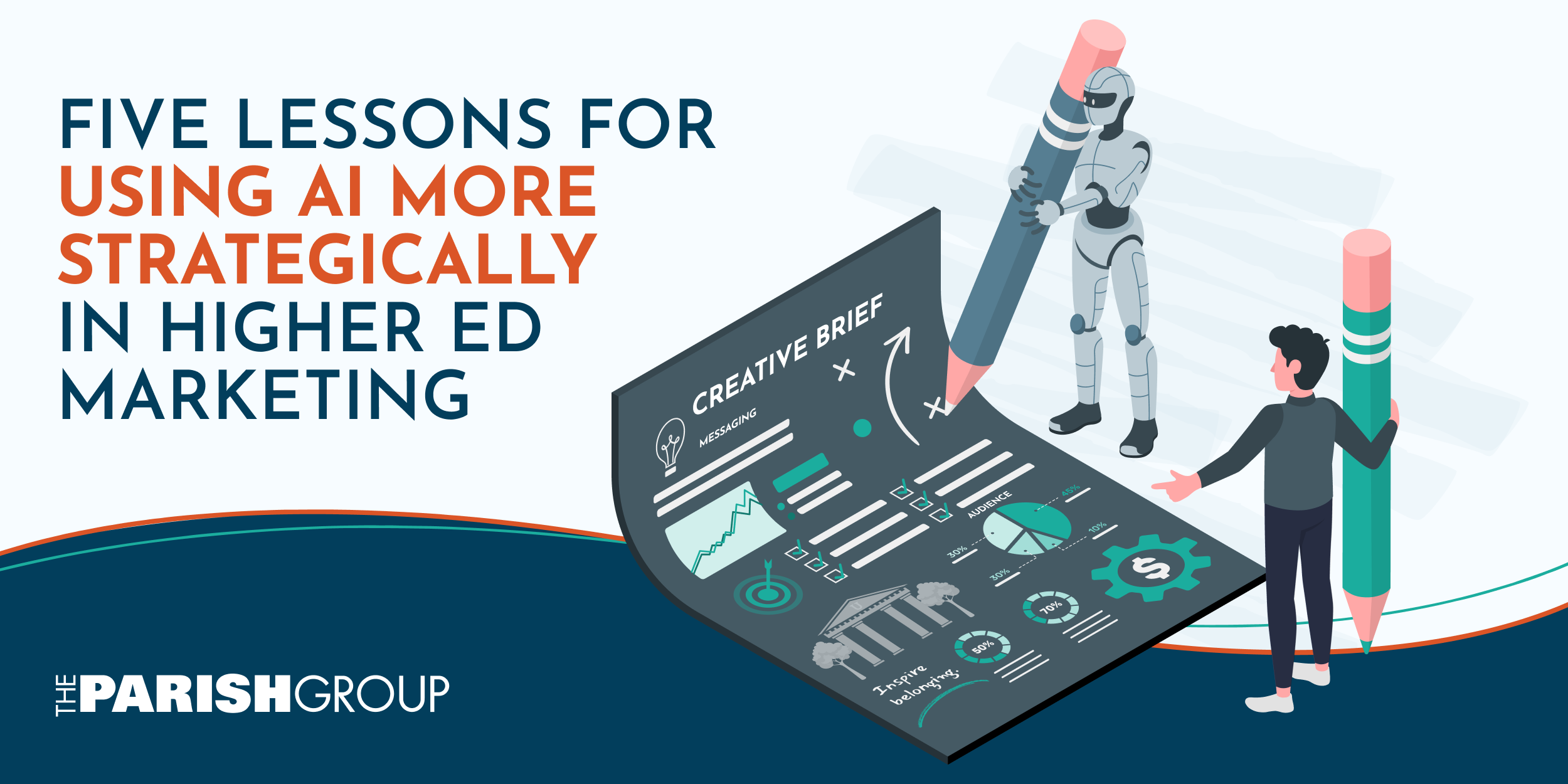
CR: Absolutely, and it comes right down to the need for a solid strategic brief.
The better the creative brief, the better the ad regardless if they were made by AI or a human. Looking at brands like Cheerios, where the key elements of heart health and doing right by your family are foundational, the brief became the center point for a strong ad. In this case, both the AI ad and the Human ad performed well. The strong strategy foundation is what made the difference.
TPG: Hypothetically, if you were not one of the people running this study, but you were head of marketing or advertising somewhere, would you use those ads?
CR: I would use AI in ad creation without hesitation especially if I need, for example, many kinds of “product” ads matched to many specific markets. The ability to customize and match messaging with marketing needs quickly and efficiently is AI’s superpower.
TPG: AI is often discussed as a productivity tool, but your research suggests there are still important differences in outcomes. How should organizations think about balancing efficiency with effectiveness?
CR: I think there’s productivity, and there’s brand needs; and you need to balance both
for effective communications. If there is no brand foundation or vision in place, AI can
create bigger problems.
Without that forethought, a brand can easily lose control of its message. Consider the
consumer backlash to some AI-created Super Bowl ads. In many cases, AI seemed to be used simply for its own sake rather than to support the brand’s vision. Marketers need to think carefully about how audiences will receive and interpret AI-generated messaging.
TPG: Do you think companies have been transparent enough about their use of AI with these skeptical audiences?
CR: Responsible marketers don’t want the consumer backlash if they find out they have been misled in any form, and that includes the use of AI. But I am also seeing a lot of ads, particularly local ones, that we can tell are using AI imagery, and thinking, do people know that? This is going to be a big issue in the coming months. States, such as NY, are already putting in laws about the disclosure of “synthetic performers” and the EU AI Act is requiring watermarks on AI work.
TPG: Your research found that people may not always be able to distinguish between AI-generated and human-created ads. If audiences cannot easily identify the source, what becomes the marker of quality?
CR: It’s all about the result, regardless of whether AI or humans are making the ad. It’s how the messaging moves the proverbial perception needle.
I think we must get over the idea that AI is this evil manipulator. In many respects, AI will
be a wonderful enabler. For now, AI will need a human guide to ensure it’s doing the
work well and with the connection the consumer desires or expects.
TPG: Why do you think there is such a backlash to it from an audience perspective?
CR: If somebody’s doing something that’s a little nefarious, there will be a backlash. No
one wants to feel duped by something that’s not human, and we live in a world
where there’s so much of it right now. What’s real and what’s not real is becoming
increasingly blurred.
TPG: Do you think transparency is more important for colleges and universities than for some other companies in their advertising?
CR: If you’re caught looking like you are trying to hide something, it’s going to come out
negatively. This generation, more than any other, prefer brands with a social conscious. They want organizations to “be the good” in the world. Companies need to stand for something, above and beyond their products. This generation expects this in all their brand interactions, including higher education.
TPG: You work with current college students. What have you observed about how students are thinking about generative AI—not just as a tool for creating content, but as something they encounter every day as consumers of information?
CR: Every student’s a little different, but there’s a little bit more trepidation with the students from the standpoint of what harm AI is doing to the environment. That’s a huge issue, and they are conflicted. What should we do, harm the world, or use AI for a career advantage?
There’s a lot of desire from the students to play, test, and discover everything AI can do. But they also understand that the implications are bigger than them, and they don’t have control. How is AI going to change the world? How’s it going to change their careers? How’s it going to change the things that they love to do? What will the machines replace? In the end, don’t we all fear these implications?
TPG: What’s important to teach a generation that’s growing up with AI, rather than learning to use it after they’ve already developed critical thinking and strategic skills?
CR: It’s about knowing how how to give students the framework and the structure of what to
look for in good and bad advertising, so that they can be the judge of what to look for and how to interpret what they’re seeing. Because the marketers that are going to succeed are the ones who can rise above the slop, do something different, stand out in a way that gets noticed, and that’s going to be the challenge for our students as they
move forward.
TPG: Are there brands your students particularly admire or think are communicating effectively? And what could colleges and universities learn from what those brands are doing?
CR: A great example would be Ben and Jerry’s. Ben and Jerry’s is a liberal brand. They convey their social and political perspectives not just on their website, but on their products and in their actions. They’re not shy about saying that’s how they feel even though not all of us agree. This mindset can grow into a very loyal consumer fan base of individuals who feel their beliefs are amplified by a brand.
Nike is another strong example. When the company supported Colin Kaepernick’s kneeling protest during the Black Lives Matter movement, it created an ad campaign around him. Some people responded by burning Nike products on livestreams, but sales rose that year as others embraced what they stood for.
Authenticity is key in all these cases. In other words, don’t promote your environmental consciousness, if you happen to sell plastic bags.
TPG: As AI makes it easier to create more content, how can organizations make sure their marketing still stands out?
CR: Marketers who don’t use AI effectively are going to be invisible because much of our advertising is easy to ignore. Putting the human connection front and center is key to successful marketing.
This interview has been edited for length and clarity.