Colleges and Universities Still Benefit From a Paper Trail
“Print is dead” (or dying) is a common sentiment (and discourse) for anyone working in the marketing/publication/communication space.
We see it in headlines, feel it when major print touchstones shutter, and we’re fed it by vendors and thought leaders who often benefit from more things being fully digitized.
And in many regards, there’s some truth to it. Often, email makes more sense than a letter or postcard. A website is the best place to holistically showcase your brand and values. Today’s students are discovering colleges and universities via social media, and for institutions facing tight marketing budgets, the cost of printing and mailing materials can make digital communication an appealing alternative. Paper costs can fluctuate, making print budgets harder to predict, while digitizing materials can also help institutions reduce waste and support sustainability goals.
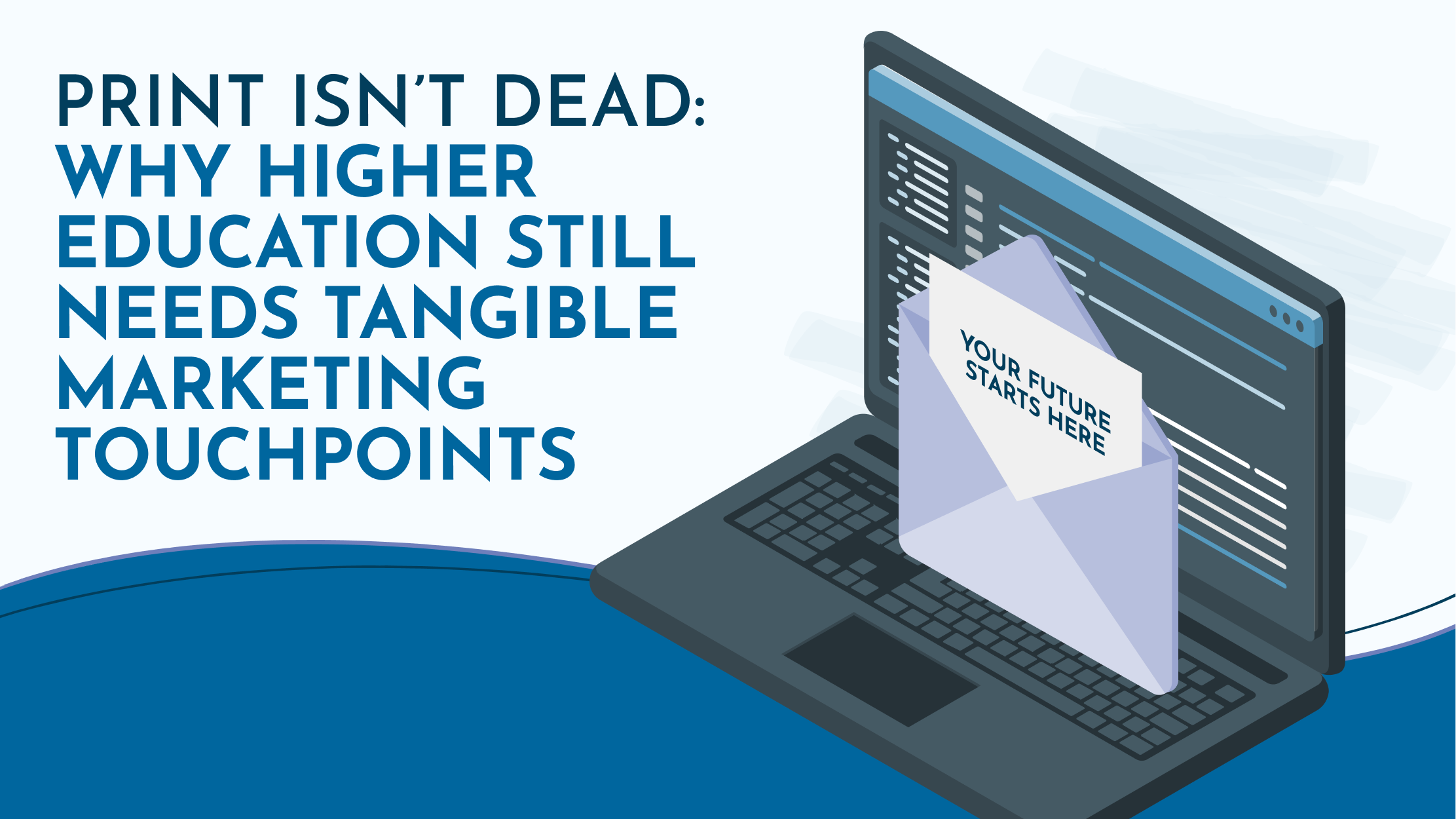
So, is print still effective for higher education marketing? We think the answer is yes—but not because print should replace digital. We’re not advocates of being analog simply to make a point. It needs to be intentional, strategic, and purposeful. Print is most effective when it complements digital communication, creating tangible touchpoints that capture attention, reinforce a message, and give students and families something to hold on to, revisit, and share.
While digital communication has transformed the way colleges and universities communicate—allowing institutions to reach audiences quickly, personalize messages at scale, and measure engagement in ways that were once impossible—there are still situations (many, we’d argue), where print communication (hang-it-on-the-fridge-or-wall/put-it-on-your-desk-or-coffee-table communication) holds more power.
Because in a world filled with notifications, crowded inboxes, algorithm-driven feeds, and now AI-generated content, there is something increasingly valuable about creating a moment someone can physically experience rather than just passively scroll by.
Print Isn’t Competing With Digital—It’s Complementing It
One of the biggest misconceptions about print is that it exists in opposition to digital.
It doesn’t. And that’s never been the case (again, we feel compelled to point out that many of the folks/organizations perpetuating that narrative benefited from that narrative; the same way many of the folks/organizations pushing the narrative that AI will replace people themselves benefit from the proliferation of AI).
The strongest marketing strategies don’t ask, Should we use print or digital? They ask, What role should each channel play?
Digital excels at speed, accessibility, and personalization. It allows colleges and universities to communicate quickly, share timely updates, answer questions, and move students through increasingly personalized enrollment journeys.
Print excels at something different. And given how much digital content exists—and how acutely aware Gen Z and A are of its creation—a thoughtfully designed print piece signals intentionality. It tells the recipient this wasn’t simply another automated touchpoint. It was created to be held onto, shared with family, revisited, and experienced in a way that few digital communications ever are.
Across the enrollment journey, strategic print can serve several different purposes:
- Following up on a campus visit confirmation email with a personalized postcard to keep the institution top of mind.
- Creating a coffee table-style viewbook or institutional magazine that invites prospective students and their families to spend time exploring the campus story long after they’ve closed their laptop.
- Including a printed academic program guide in an admitted student packet that families can flip through together at the kitchen table.
- Mailing a handwritten welcome note from an admissions counselor after a student is accepted, adding a personal touch to an otherwise digital enrollment process.
- Pairing a printed viewbook with QR codes that lead to virtual campus tours, student stories, or program-specific videos, allowing students to seamlessly move between print and digital.
- Sending an alumni magazine that drives readers online to register for events, watch student stories, or update their contact information.
In each of these examples, print isn’t replacing digital. It’s extending it.
The goal isn’t to ask audiences to choose between the two. It’s to create a communication experience where each channel does what it does best. And for a generation that understands just how easy it is to send another email or publish another post, that extra level of thought and intention doesn’t go unnoticed.
Attention Is the Scarcest Resource and Print Earns More of It
Today’s students are among the most digitally connected generations in history. But being digital-first doesn’t mean every meaningful interaction has to happen digitally.
Every email competes with dozens of unread messages. Every social media post is fighting an algorithm. Every website vies for attention alongside open tabs, text messages, streaming services, AI chatbots, and an endless stream of notifications. In today’s attention economy, the challenge isn’t simply getting your message in front of someone—it’s getting them to stay with it.
Print competes differently.
A thoughtfully designed publication may not have to compete for attention in an inbox or social feed, but that doesn’t mean it gets a free pass in the mailbox. It can still arrive alongside other publications, advertisements, and bills, which is why the design and execution matter. If you’re going to invest in print, make it stand out. Give someone a reason to pick it up, open it, and spend time with it.
Once it earns that initial attention, print has another advantage: it can sit on a coffee table, remain on a desk, or be pinned to a refrigerator, creating multiple opportunities for engagement long after it’s been delivered. Rather than asking for a few seconds of attention, it can earn minutes—or even repeated interactions over days or weeks.
That’s one of print’s greatest strengths. It invites people to slow down.
Think about the materials students and families are most likely to keep:
- An acceptance letter that marks the beginning of a new chapter.
- A campus visitor guide that’s revisited while comparing institutions.
- An admitted student packet spread across the kitchen table as families talk through one of the biggest decisions they’ll make together.
- An orientation guide referenced throughout the first weeks on campus.
- A beautifully designed institutional magazine or viewbook that continues telling your story long after a browser window has been closed.
A reel can be scrolled past without a second thought. An email can be skimmed and archived (or…not delivered for a variety of reasons). A website can be opened among a dozen other tabs and forgotten. None of that diminishes the value of those channels—they are essential parts of a modern communication strategy. But the ecosystem they exist in is designed for speed, immediacy, and constant competition for attention.
That kind of sustained attention—and the emotional connection that often comes with it—is increasingly difficult to create through a screen alone.
The Distinctiveness of Print Is Part of Its Value
The declining ubiquity of print is also part of what makes it valuable today—especially for younger audiences.
Gen Z and Gen Alpha have grown up in an environment where digital communication is constant. They receive countless emails, notifications, social media posts, and digital messages every day. As a result, another digital touchpoint can easily blend into the background, and print becomes something they value (62% of Gen Z students prefer print textbooks over digital formats). It becomes more intentional and memorable.
The Future of Higher Education Marketing Is More Intentional, Not More Digital
The future of higher education marketing isn’t print or digital—it’s knowing when and how to use both.
Digital remains essential for speed, accessibility, personalization, and timely communication. Print remains valuable when institutions want to create a tangible, memorable experience. The strongest strategies aren’t choosing one over the other; they’re using each channel intentionally based on the audience, message, and moment.
Print isn’t valuable because it replaces digital. And digital isn’t valuable without print. The strongest communication strategies recognize that there’s no single right way to reach all your audiences. There are many.
See How Strategic Print Can Support the Enrollment Journey
Print is most effective when it has a clear purpose—supporting students and families with the right message, in the right moment, and in the right format. It also needs to look and feel like part of a cohesive brand while standing out from everything else competing for attention in the mailbox.
In our work with Lenoir-Rhyne University, we helped expand publication assets across the enrollment funnel by creating resources to support prospective students, admitted students, and the broader campus community.
Explore the case study to see how an intentional print strategy can complement digital communication and create more meaningful connections with audiences.